

🔍 What Is Shaping in Dog Training?
Shaping in dog training is a powerful behavioral training technique based on rewarding incremental progress toward a desired behavior. It’s like teaching your dog in baby steps—one success at a time—until they master something amazing.
Instead of waiting for a dog to magically perform the full command, shaping in dog training builds it piece by piece. Whether you’re training a beginner pup or refining an advanced skill, this method taps into how dogs naturally learn—through cause and effect.
Shaping has its roots in behavioral psychology, pioneered by B.F. Skinner in the 1930s. Unlike traditional command-based training that relies on physical guidance or corrections, shaping empowers dogs to think and problem-solve independently. This approach works particularly well alongside positive reinforcement techniques that build trust and confidence.
Modern professional dog trainers increasingly favor shaping because it builds neural pathways that enhance learning capacity. When dogs discover behaviors through their own trial and error, they retain these lessons longer and perform more reliably. Shaping also eliminates the stress and confusion that can arise from physical manipulation or harsh corrections.
Clicker training serves as the perfect partner to shaping, especially when combined with capturing techniques that reward naturally occurring behaviors.
The distinct sound marks the exact moment your dog performs the desired behavior, creating crystal-clear communication. This precision timing helps dogs understand exactly what earned them the reward, accelerating the learning process dramatically.
🎯 Why Use Shaping in Dog Training?
Most behaviors you want from your dog (like loose leash walking, settling on a mat, or ignoring distractions) are too complex to teach in one leap. That’s where shaping shines. It lets you:
- Break big behaviors into tiny wins
- Reinforce learning every step of the way
- Keep training positive, engaging, and clear
📌 Example: Want your dog to go to their bed when the doorbell rings? With shaping, you’d first reward looking at the bed, then stepping toward it, then placing a paw on it—until “go to bed” becomes second nature.
Certain breeds particularly excel with shaping techniques. Border Collies, Poodles, and German Shepherds thrive on the mental stimulation shaping provides, while gentler breeds like Golden Retrievers appreciate the pressure-free environment. However, every dog can benefit regardless of breed.
Age plays a crucial role in shaping success. Puppies between 8-16 weeks are especially receptive, as their brains are primed for learning. This makes shaping an ideal foundation for comprehensive puppy training programs that set dogs up for lifelong success.
Research shows that dogs trained with shaping methods display 40% less stress-related behaviors during training sessions compared to traditional methods. This creates a positive feedback loop where both dog and owner enjoy the process, leading to more consistent training sessions and faster results.
Shaping can also be used to develop a variety of useful or just-for-fun behaviors. From agility training to polite greetings, shaping builds precision and enthusiasm in dogs of all breeds and ages.
Another advantage? It keeps training sessions interesting and mentally stimulating, which can help prevent boredom and behavioral issues. Dogs that are encouraged to think and problem-solve are typically calmer and more adaptable.
🧬 How Shaping Works: The Psychology Behind It
Shaping in dog training is rooted in operant conditioning, a learning process where behaviors are strengthened or weakened by consequences. Every reward your dog receives for an action makes that action more likely to happen again.
It’s also linked to successive approximation—rewarding behavior that’s closer and closer to the goal. This is how wild animals are trained to perform complex tricks… and why it works wonders with your pup.
📄 Research Insight: Studies in animal behavior show that shaping enhances a dog’s cognitive flexibility, helping them adjust to changing criteria faster than dogs trained using only luring.
🚀 Bonus: Shaping builds problem-solving skills and confidence in your dog. They learn how to learn. This sense of accomplishment increases their willingness to try new behaviors and reduces hesitation.
Essential Tools for Effective Shaping
Clickers and Timing
A quality clicker produces a consistent, distinct sound that cuts through distractions. Hold the clicker in your non-dominant hand, keeping it ready but relaxed. The golden rule: click first, then treat. This sequence ensures your dog connects the sound with the behavior, not the food.
High-Value Rewards
Success depends on using rewards your dog finds irresistible. Understanding positive reinforcement fundamentals helps you choose the most effective rewards for your individual dog.
Freeze-dried liver, tiny pieces of chicken, or special training treats work best. Keep rewards smaller than your pinky nail—you’ll be giving many throughout each session. Room-temperature treats prevent sticky fingers and maintain your dog’s focus.
Training Environment
Start in a quiet, familiar space with minimal distractions. Your living room works perfectly for initial sessions. As your dog progresses, gradually introduce mild distractions like background noise or family members moving about. This builds reliability in real-world situations.
Progress Tracking
Keep a simple training journal noting what behaviors you shaped, how many repetitions it took, and your dog’s mood. This helps identify patterns and adjust your approach. Many trainers use smartphone apps to track training sessions and set reminders for daily practice.
🧪 Shaping vs. Luring vs. Capturing
Let’s break it down:
| Technique | How It Works | When to Use |
|---|---|---|
| Luring | Uses treats to guide a dog’s body | Best for simple behaviors like “sit” or “down” |
| Capturing | Rewards behaviors that happen naturally | Great for behaviors your dog already offers |
| Shaping | Rewards progressive steps toward goal | Ideal for complex behaviors or building focus |
Shaping in dog training requires more patience than the other two, but it leads to a deeper understanding of the desired behavior. It also avoids reliance on hand signals or food prompts, which can become crutches if not faded out.
🔗 See our full comparison of dog training methods →

🛠️ How to Use Shaping (Step-by-Step)
- Pick a clear end goal.
→ Example: Dog lies calmly on mat for 60 seconds. - Identify the first small step.
→ Maybe just looking at the mat. - Mark and reward that behavior.
Use a clicker or a consistent marker word like “yes!” - Wait for a slightly improved behavior.
→ Now reward a step toward the mat. - Continue rewarding closer approximations.
- Only raise the criteria when your dog is confidently repeating the current step.
Mastering Your Timing
Perfect timing separates good trainers from great ones. Click the instant your dog performs the desired behavior—even a fraction of a second late can confuse your dog about what earned the reward. Practice clicking and treating with a friend before working with your dog to develop muscle memory.
Avoiding Early Mistakes
New shapers often click too frequently, making every small movement seem important. Be selective—only click behaviors that move toward your goal.
Also resist the urge to help physically guide your dog. This patience-based approach differs significantly from classical conditioning methods that rely on automatic responses to specific triggers.Let them figure it out; this builds confidence and stronger neural pathways.
Maintaining Motivation
Keep sessions short and sweet—5 to 10 minutes maximum. End on a high note when your dog successfully performs the behavior. If frustration creeps in for either of you, take a break. A refreshed mind learns faster than a tired one.
Knowing When to Stop
End each session before your dog loses interest. Watch for signs like decreased enthusiasm, looking away, or slower responses. These indicate mental fatigue. A dog that’s eager for the next session will progress much faster than one that’s been pushed too hard.
🧠 Pro Tip: If your dog gets frustrated, go back to the last successful step. Shaping isn’t linear. Regression is part of the learning curve.
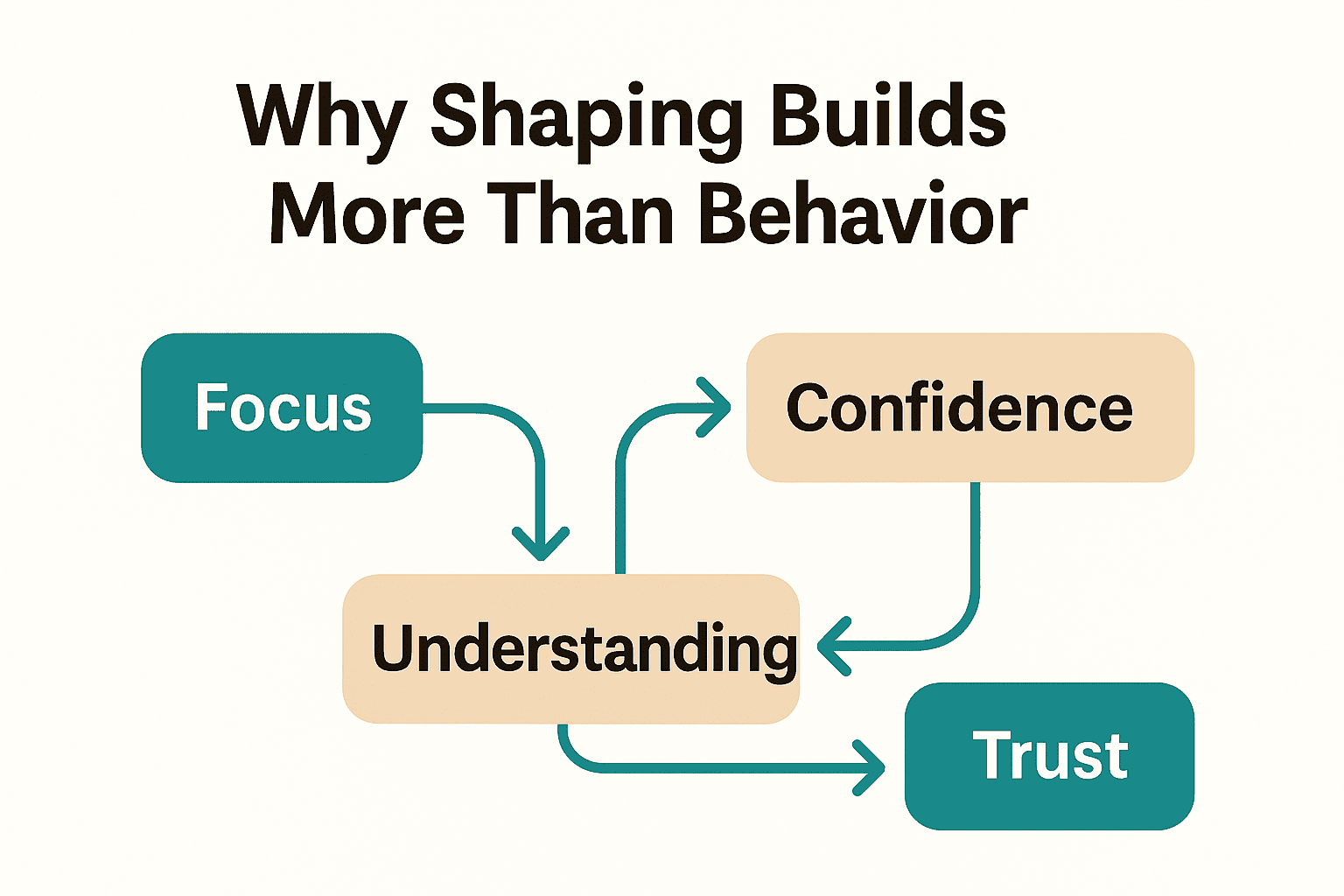
🧩 Why Shaping Builds More Than Behavior
Shaping strengthens your dog’s:
- Focus: They’re actively watching for cues.
- Confidence: Success builds momentum.
- Understanding: Clear feedback reduces stress.
It also builds your training skills. You’ll become more aware of timing, reinforcement schedules, and reading your dog’s signals.
Shaping encourages trainers to slow down, observe, and adapt. This creates a better bond and more resilient learning.
Advanced Shaping Techniques for Complex Behaviors
Behavior Chaining
Once your dog masters individual behaviors, you can chain them together into complex sequences. Start by teaching each behavior separately, then gradually link them. For example, combine “fetch,” “sit,” and “drop it” into one fluid routine. This technique creates impressive tricks and practical skills.
Service Dog Applications
Shaping proves invaluable for training service dogs to perform intricate tasks. Opening doors, retrieving specific items, and alerting to medical conditions all benefit from shaping’s precision.
The dog learns to problem-solve variations of the task, creating more reliable service behaviors. This problem-solving ability also helps with common dog behavior issues that require thoughtful, customized solutions.
Athletic Training
Agility competitors rely heavily on shaping for complex obstacle work. Dogs learn to adjust their approach based on their handler’s position, speed, and cues. This creates the fluid partnership that wins competitions. Even recreational activities like frisbee or dock diving benefit from shaping techniques.
Problem-Solving Behaviors
Advanced shaping develops your dog’s ability to think through challenges independently. Teaching your dog to close doors, turn off lights, or find hidden objects builds cognitive flexibility. These problem-solving skills transfer to other areas, creating a more adaptable, intelligent companion.
📉 Troubleshooting Common Shaping in Dog Training Mistakes
If your dog shows signs of stress or frustration during shaping sessions, consider whether separation anxiety or other behavioral concerns might be affecting their ability to focus. Addressing underlying issues first often leads to more successful training outcomes.
Mistake: Raising the bar too fast
Fix: Reward smaller steps. Watch for signs of confusion.
Mistake: Dog stops trying
Fix: Lower the criteria and get back on a success streak.
Mistake: Repeating same step too long
Fix: If your dog’s offering the same thing over and over, raise the criteria slightly.
Mistake: Relying on prompts or cues too soon
Fix: Let the dog figure it out. Avoid jumping in to “help.”
For a deeper dive into shaping and other positive training strategies, explore the Karen Pryor Clicker Training guide on shaping behavior. Learn from the pioneers of force-free training and get practical tools from science-backed behaviorists.
🗺 Real-Life Examples of Shaping
For dogs who struggle with leash manners, shaping offers a gentler alternative to traditional corrections. Learn more about comprehensive dog walking techniques that complement shaping methods.
🚴 Loose Leash Walking
Start with one step next to you. Reward that. Add a second. Gradually increase the number of steps. Eventually, walking politely becomes the norm.
🛏 Crate Training
Reward your dog for sniffing the crate, then stepping inside, then settling. Don’t shut the door too early.
🧽 Trick Training
Teach a spin or bow by clicking for head turns, body shifts, then full movement.
👋 Greeting Visitors
Start by reinforcing calmness while someone stands nearby. Then as they approach. Then as they speak.
These examples highlight how versatile and effective shaping can be when done with intention.
🛃 Wrap-Up: Trust the Process
Shaping turns training into a fun, collaborative process. It’s less about commands and more about communication. Start with something simple. Celebrate small wins. And remember—every “yes!” builds a better bond.
It’s not just about obedience. It’s about understanding, trust, and growth. This foundation makes shaping an excellent complement to crate training and other essential life skills that benefit from patient, positive approaches.