

This is happening: Your dog bolts toward the door or barks wildly when someone knocks or enters. If your dog struggles to stay calm when people enter, this calm dog greetings protocol will show you how to fix the chaos—step by step.
So do this: Use this Calm Door Greeting Protocol.
Step 1: Teach a “Place” Behavior Away from the Door
- 🪑 Pick a mat, bed, or rug 6–8 feet from the door
- 🧀 Lure your dog to it and mark with a click or “Yes”
- 🔁 Repeat this several times, then start adding a cue like “Place”
- ⏳ Increase duration of stay using high-value treats and short bursts of training
Step 2: Trigger Training with Simulated Door Arrivals
- 🚶 Have a family member knock or ring the bell while you’re in position
- 🔊 Use a calm interrupter word like “Enough” when they bark
- 🧠 Redirect to “Place” — even if they break, calmly return them
- 🎁 Reward heavily for staying on the mat while the door opens/closes
Step 3: Guest Entry With Structure
- 🔗 Leash your dog if needed while practicing
- 🚫 Instruct guests: no talk, no touch, no eye contact
- 🐾 When your dog is calm for 3–5 seconds, let guest toss a treat (no petting yet)
- 🧘♂️ If they stay calm, release them with a phrase like “Say hello” — otherwise, back to Place
Step 4: Practice Mini Sessions Regularly
- 🕒 Keep sessions short (under 10 minutes)
- 🔁 Repeat door triggers with no guest — just practice!
- 🧱 Build the pattern: doorbell = go to place = reward
Bonus: Daily Energy Management
- 🏃♂️ Give your dog a walk or sniff session before guests arrive
- 🍖 Use a frozen lick mat or snuffle mat during visits
- 📦 Provide chew toys post-greeting to decompress
What NOT to Do
- ❌ Don’t scold, yell, or physically block
- ❌ Don’t let guests pet or excite your dog right away
- ❌ Don’t expect instant perfection — this is learned calmness
Tools That Help
- 🎯 Long lead or slip leash
- 🪄 Clicker or verbal marker (“Yes!”)
- 🧸 Snuffle mat, treat pouch, high-value soft treats
- 🛏️ Elevated dog bed for clearer Place training
🐶 Try the Dogo App – Calm Your Dog with Science →
🟩 Calm Dog Greetings Start With Structure
Your dog rushing the door is a symptom of overstimulation and a lack of structure — not a sign of dominance or disobedience. By teaching them a simple “Place” routine, you replace chaos with calm predictability.
Your dog wants clarity. Give it through patterns.
Case Study: From Chaos to Calm at the Front Door
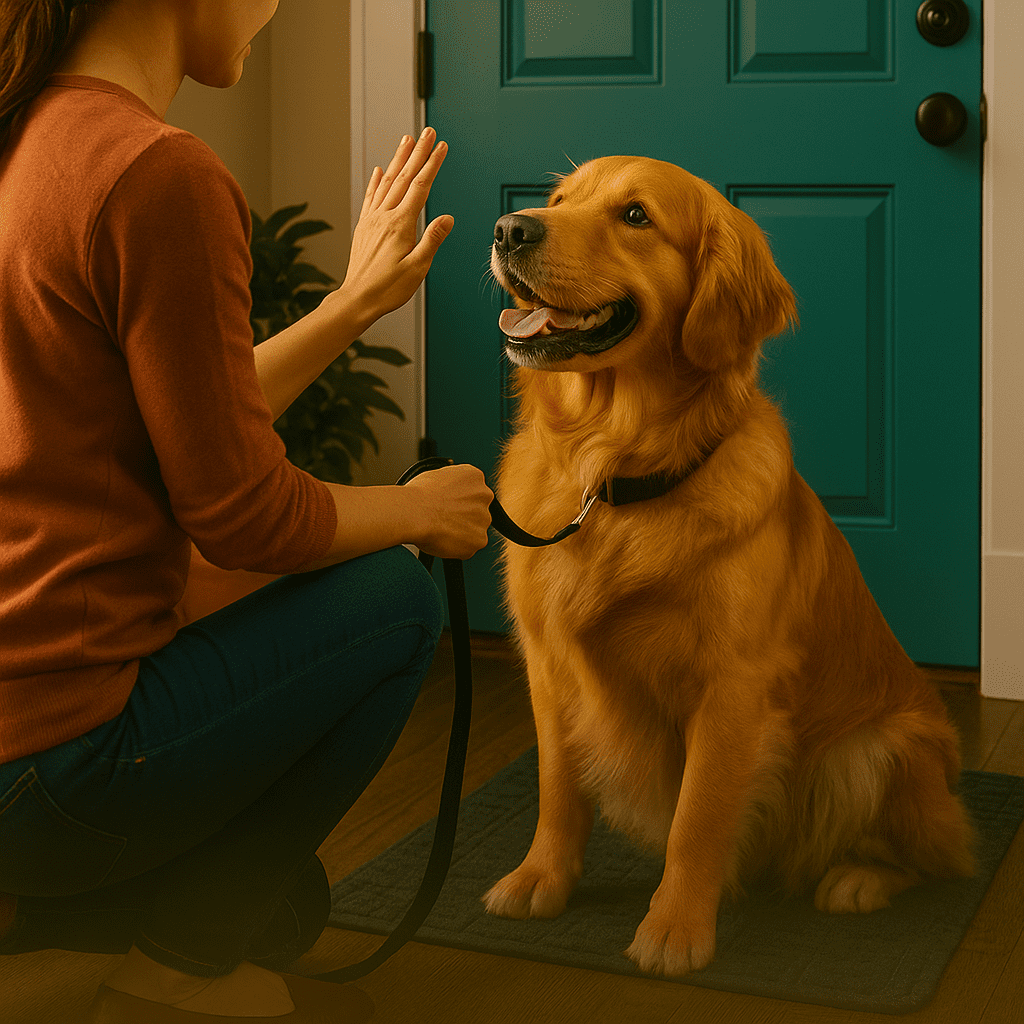
Maya, a 3-year-old Golden Retriever, used to lose control every time the doorbell rang. She’d leap at the door, bark frantically, and overwhelm every guest with uninvited enthusiasm. Her guardian, Lisa, had tried everything—yelling, leashing, even isolating Maya during visits—but nothing worked.
That changed when Lisa committed to teaching calm dog greetings.
Instead of reacting to Maya’s energy, Lisa created structure. She practiced calm door greetings daily—starting with desensitizing the door knock, rewarding stillness, and using a boundary mat to help Maya hold her position. Within two weeks, Maya had stopped jumping. She would sit, tail wagging gently, waiting for permission to greet. Guests were stunned.
“She finally listens at the door,” Lisa said, tearing up. “We can breathe again. Our home is peaceful now.”
Lisa followed PupCommand’s calm dog greetings protocol exactly. By reinforcing quiet behavior and creating predictability, she rewired Maya’s excitement into trust.
This case isn’t about perfect obedience—it’s about replacing panic with connection. Calm dog greetings aren’t just a training win. They’re a relationship reset.

Christopher Quinn adopted his first dog, Loki, a spirited Border Collie/Jack Russell mix, after exiting Army service in the summer of 2012. That experience sparked a lifelong passion for canine behavior and positive reinforcement training.
He studied Principles of Dog Training & Behavior at Penn Foster and has since worked with hundreds of dogs from all backgrounds. Over the past two years, Christopher has fostered more than 30 rescue dogs, giving each one a chance at a better life.
Today, he continues to write, teach, and share insights on humane dog training, blending hands-on experience with a decade of dedicated study.