

Why “Lie Down” Matters in Dog Training
Trying to teach a dog to lie down? Teaching your dog to lie down is one of the fundamental obedience commands every dog should learn. Before starting, ensure your dog has mastered basic positive training methods and can reliably perform the stay command. When used consistently, it can:
- Help your dog settle during overstimulating situations
- Prevent jumping or overexcited behavior
- Serve as a building block for advanced cues like “stay” or “roll over”
Whether you have a puppy or an adult dog, learning how to teach a dog to lie down makes your training toolkit more effective.
🔥 Pro Tip: Timing Is Everything
Click the moment your dog’s elbows hit the ground — not before, and not after. This is how your dog understands exactly what you’re rewarding. Consistency here creates crystal-clear learning.
What You’ll Need
- High-value treats (soft, small, and irresistible)
- A quiet environment with minimal distractions
- Patience, consistency, and a positive attitude
Optional:
- A clicker for marking behavior
- A mat or training pad
Step-by-Step: How to Teach a Dog to Lie Down
1. Start with a Sit
Begin with your dog in a sitting position. This helps them naturally transition into a down posture. If your dog hasn’t mastered sitting yet, start with our basic obedience training guide.
2. Use a Treat to Lure
Hold a treat at your dog’s nose, then slowly move your hand down between their front paws and slightly forward. Most dogs will follow the treat into a “lie down” position.
3. Mark and Reward
As soon as your dog’s elbows touch the ground, use a clicker or say “Yes!” then immediately give the treat. This reinforces the correct behavior.
4. Add the Verbal Cue
Once your dog consistently follows the hand lure, introduce the verbal cue “Lie down” just before luring. Over time, phase out the lure and rely only on the cue.
5. Practice in Short Sessions
Train for 3–5 minutes a few times daily. Gradually add distractions, distance, and duration to strengthen the command.
Ava’s 5-month-old puppy, Luna, kept bouncing up anytime she tried to teach “Lie Down.” So Ava calmly waited until Luna was tired after playtime, then lured her into a down position with a piece of boiled chicken. The moment Luna’s chest touched the ground, Ava softly said, “Good girl, lie down” and gave the treat. After a few quiet repetitions in that relaxed state, Luna began to understand. Now she lies down faster each time — no frustration, just gentle consistency.
Common Mistakes to Avoid
- Repeating the cue: Say “Lie down” once, then wait. Repeating can dilute the command.
- Using force: Never push your dog into position. This causes stress and confusion.
- Not reinforcing enough: Reward generously in the early stages to build a positive association.
- Training when your dog is overstimulated: If your dog shuts down during training, take a break and adjust your approach.
Troubleshooting Common Lie Down Training Challenges
Many dog owners encounter specific hurdles when teaching their dog to lie down, especially with certain breeds and temperaments. If your dog consistently resists the down position, consider their physical comfort first. Large breed dogs like German Shepherds or Golden Retrievers may need extra encouragement on hard surfaces, while smaller breeds might feel vulnerable lying down in open spaces.
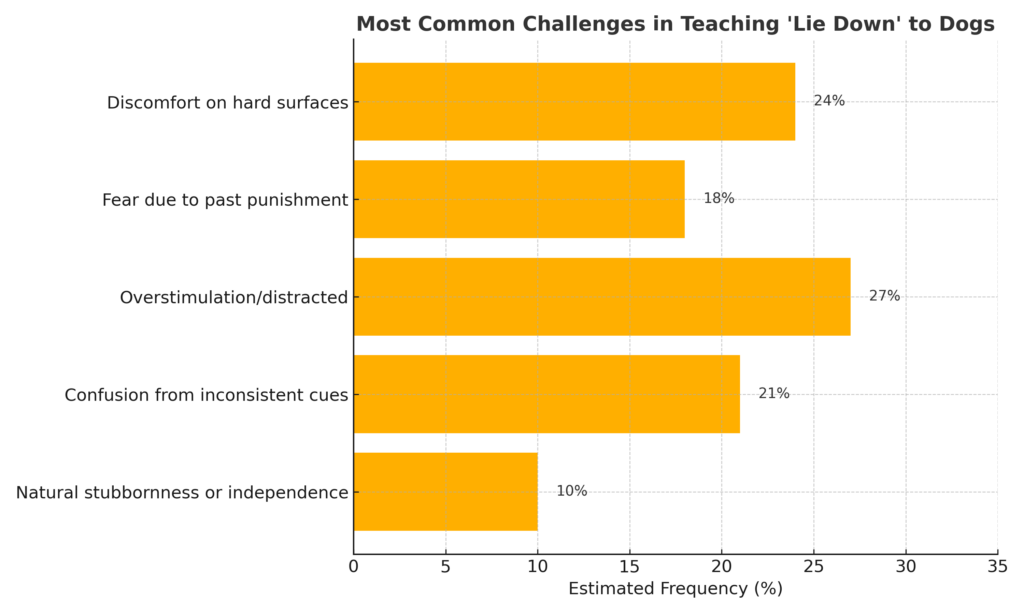
Some dogs have been inadvertently trained to associate lying down with negative experiences. Rescue dogs, in particular, may have learned that the down position signals submission or punishment. For these dogs, patience and positive reinforcement become even more critical. Teach a dog to lie down by starting to rewarding any lowering motion, even if your dog doesn’t achieve a full lie down initially.
Timing plays a crucial role in successful dog training. Practice the lie down command when your dog is naturally calm—after a walk or play session works best. don’t teach a dog to lie down during high-energy periods or when your dog is overstimulated by visitors or other distractions.
Remember that consistency in your verbal cue matters tremendously. Whether you say “lie down,” “down,” or “place,” stick with one command throughout the training process. Mixed signals confuse dogs and significantly slow their learning progress, making this foundational obedience skill harder to master.
Benefits of Teaching Your Dog to Lie Down
- Promotes relaxation during overstimulating environments (e.g., vet offices, guests arriving)
- Prepares for stay and settle commands, critical for long-duration control
- Reinforces your leadership role through consistent, calm communication
Advanced Lie Down Practice
- Add the ‘stay’ command to the ‘lie down’ command to increase impulse control.
- Use duration training by slowly extending how long your dog remains in the down position.
- Practice the ‘place’ command as a natural progression from lie down.
- Incorporate into crate training routines for better settling behavior.
Whether you have a puppy or an adult dog, learning how to teach a dog to lie down makes your training toolkit more effective. The American Kennel Club recognizes “down” as one of the most basic and useful behaviors every dog should master.
How to Teach a Dog to Lie Down in Real Life Situations
- Before meals to create calm anticipation
- At doorways to prevent darting
- At the vet or groomer for cooperative care
- In public (e.g., cafes, parks) for polite behavior
🐾 Want More Positive Training Success?
Learn the Science of Positive ReinforcementFinal Tips for Success
- Use positive reinforcement consistently
- End on a success—don’t train until your dog gets frustrated
- Stay patient and celebrate progress
- Consider breed-specific needs: Golden Retrievers often learn quickly, while Border Collies may need more mental engagement during training.

Christopher Quinn adopted his first dog, Loki, a spirited Border Collie/Jack Russell mix, after exiting Army service in the summer of 2012. That experience sparked a lifelong passion for canine behavior and positive reinforcement training.
He studied Principles of Dog Training & Behavior at Penn Foster and has since worked with hundreds of dogs from all backgrounds. Over the past two years, Christopher has fostered more than 30 rescue dogs, giving each one a chance at a better life.
Today, he continues to write, teach, and share insights on humane dog training, blending hands-on experience with a decade of dedicated study.