
🐶 Positive Reinforcement 101: The Foundation of Better Behavior
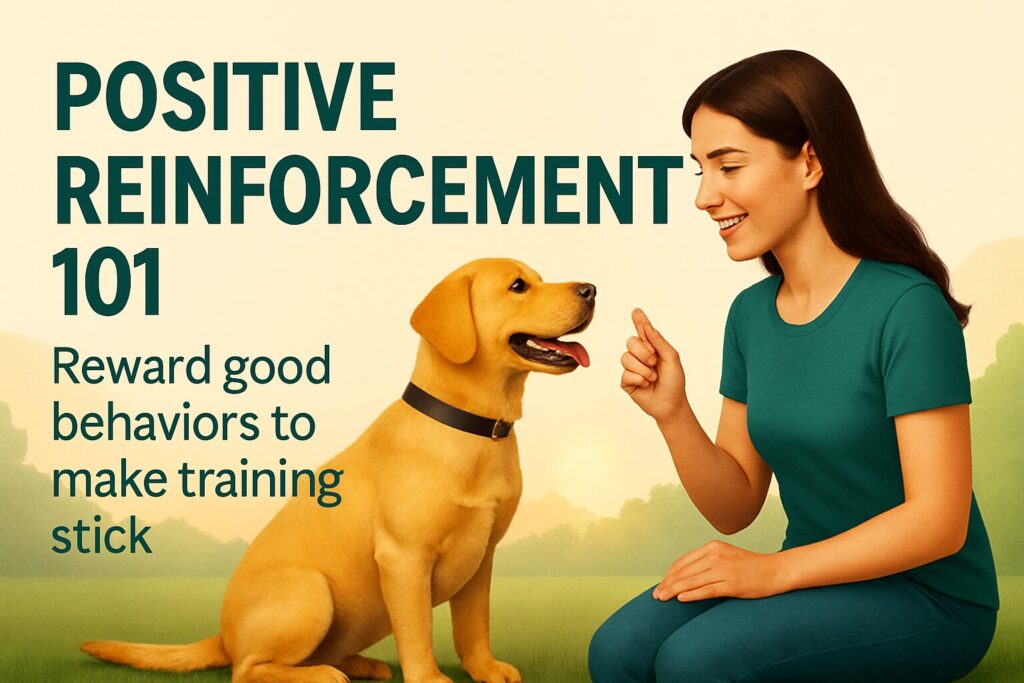
Welcome to the foundation of modern, science-based dog training: Positive Reinforcement.
This method strengthens your dog’s good behaviors by pairing them with rewards they love—like treats, praise, or play—so they choose those behaviors again.
In scientific terms, positive reinforcement is one of the four quadrants of operant conditioning. It works by adding something rewarding immediately after a desired behavior to increase the chance your dog will repeat that behavior in the future.
This page is your beginner’s compass, helping you understand why rewarding the right behaviors is more powerful than punishing the wrong ones.
Positive reinforcement 101 in dog training is the practice of adding a desirable stimulus immediately after a dog performs a desired behavior, which increases the likelihood that the behavior will happen again.
🧪 Breakdown:
- “Positive” means something is added
- “Reinforcement” means the goal is to increase a behavior
This method is rooted in behavioral psychology, specifically operant conditioning, and is widely considered the most humane, effective, and scientifically supported approach to dog training.
✅ Why Positive Reinforcement in Dog Training Works
Timing matters.
Dogs don’t replay events—they react to what’s happening right now. That means the reward needs to come within 1–2 seconds of the behavior you want to reinforce. Any longer and they may associate the treat with something else entirely.
Consistency builds habits.
Every time your dog does something right and gets rewarded for it, the behavior becomes more automatic. Over time, these reinforced behaviors stack up to create a calm, confident, well-trained dog.
Positive reinforcement means catching your dog doing something right—and letting them know just how amazing that was. Whether it’s a treat, praise, or playtime, these rewards make good behavior stick. Why? Because dogs repeat what works. When good things happen after a behavior, your dog naturally wants to do it again.
This works whether you’re addressing crate training challenges or nighttime barking issues.
It’s not about domination. It’s about connection.
This method creates confident dogs and happy humans. No fear. No confusion. Just a partnership built on trust.
Positive reinforcement is not bribery.
You’re not spoiling your dog—you’re reinforcing decisions. A common myth is that treats are bribes. In reality, bribery happens before a behavior (“Do this or else”), while positive reinforcement rewards after the behavior (“Well done, do that again!”). The difference matters.
🎯 What This Page Will Help You Do
✅ Understand the science behind positive reinforcement in clear, emotionally-driven terms
✅ Get instant access to our free Dog Training Quiz Pack (CTA below ⬇️)
✅ Link to an in-depth article for advanced insights
✅ View a visual comparison infographic that shows how reward-based training stacks up against outdated methods
✅ Connect to specific solutions like teaching your puppy basic commands
⚠️ Why We Avoid Punishment-Based Training
NOTE from Chris:
In the 1990s, the dog training world was dominated—literally—by the idea of control through fear. The “Dominance Theory” ruled the day, encouraging harsh discipline, rigid rules, and physical punishment for dogs who didn’t comply.
And for a time, it seemed to work.
Dogs obeyed—not out of understanding or trust—but out of fear.
But here’s the truth: fear-based obedience comes at a devastating cost.Dogs are intelligent, emotional beings. When constantly punished, they don’t learn what to do—they simply learn to avoid pain. That obedience is fragile, built on anxiety, not trust.
Eventually, something snaps.
Traumatized dogs, backed into a corner with no way to escape, do what any living being would do when threatened: they fight back.
Too many handlers were bitten.
Too many loyal family dogs, misunderstood and mistreated, were euthanized to “protect” humans from behavior we ourselves created.
💡 That’s why at Pup Command, we lead with science, not fear.
We choose positive reinforcement—because trust lasts longer than fear, and connection builds behavior that sticks. Ready to put this into practice? Start with our complete puppy training guide for new owners or tackle specific challenges like indoor potty training.
Master these other 4 Principles – Build REAL behavior that sticks for life.
At its core, Positive Reinforcement is more than a technique—it’s a mindset. When you lead with trust and encouragement, your dog learns to love learning. Every reward strengthens your bond and turns progress into a lifelong habit.