
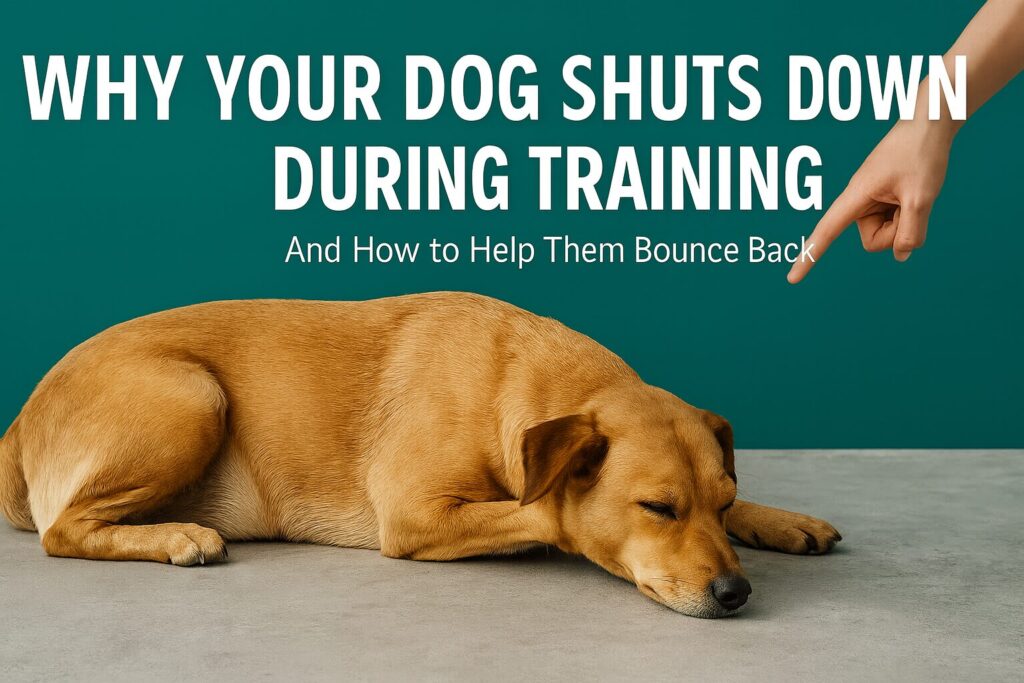
Is your beloved canine companion suddenly disengaging, refusing commands, or acting unresponsive during dog training sessions? This behavior, often termed ‘dog shutdown in training,’ can be incredibly disheartening for any pet owner.
It’s more than just a distraction; it’s a clear signal that your dog is feeling overwhelmed, stressed, or misunderstood.
This comprehensive guide will explain why your dog shuts down during training and, more importantly, provide actionable dog training solutions to help your canine companion bounce back from training stress and regain their confidence and joy in learning. Discover practical positive reinforcement dog training techniques to transform frustrating moments into successful, bond-building experiences.
Training a dog should be a partnership, not a power struggle. But what happens when your dog suddenly stops responding — or worse, freezes, flattens to the ground, or walks away?
🧠 What Does “Shutting Down” During Training Actually Mean?
Dog shutdown refers to a state where a dog becomes unresponsive, disengaged, or entirely withdrawn during a dog training session. It’s not about defiance or a lack of understanding; rather, it’s a coping mechanism in response to overwhelming pressure, confusion, or fear. Recognizing these dog behavior cues is vital. Signs your dog might be shutting down include:
- Lack of eye contact or actively looking away
- Refusal to take treats or engage with toys
- Excessive yawning, lip licking, or sniffing (displacement behaviors indicating dog stress)
- Excessive panting without exertion
- Freezing, lying down, or becoming completely still
- Appearing ‘checked out’ or mentally absent
Understanding these dog stress signals is crucial for effective dog training and preventing long-term dog anxiety related to learning. This isn’t stubbornness — it’s a stress response. In many cases, it means your dog is confused, overwhelmed, or emotionally flooded.
Dogs show signs of stress in subtle ways — like freezing, turning away, or going limp — and it’s crucial to recognize these before they escalate. According to PetMD’s guide on stress in dogs, behaviors like lip licking, excessive yawning, or tail tucking are all signals your dog may be emotionally overwhelmed.
⚠️ Why Dogs Shut Down During Training
Real-Life Snapshot: Milo and the Clicker Incident
Milo was a bright, eager 7-month-old Border Collie mix, always ready to please — until one afternoon during a basic obedience session, everything changed.
His owner, excited to reinforce a “down-stay,” used a louder clicker than usual and leaned over Milo while giving the cue. The response was immediate: Milo’s ears pinned back, his tail tucked, and he slowly lay down… then froze.
Offered a treat, he looked away. His eyes were wide, his body still. He wasn’t being disobedient — Milo had shut down.
From the outside, it looked like stubbornness. But in truth, Milo’s nervous system had switched into survival mode.
When the environment shifted — the clicker removed, voice softened, posture lowered, and play introduced — Milo came back. His tail wagged, his eyes brightened, and within minutes, he was fully engaged again.
This is the critical difference between pressure… and partnership.
1. Confusion or Mixed Signals
Imagine trying to follow instructions in a language you barely understand, repeated over and over. If your cues are unclear, inconsistent, or change too quickly, your dog can become mentally overwhelmed.
2. Too Much Pressure, Too Soon
Expecting perfect behavior without sufficient reinforcement, or moving too quickly from luring to verbal commands, can lead to emotional shutdown. Dogs, especially sensitive ones, need training broken into baby steps.
3. Negative Associations
Dogs previously trained with aversives (like yelling, leash corrections, or dominance-based tactics) may associate training with punishment or failure. Even a raised voice can trigger a freeze response in some.
4. Environmental Stress
A training environment that’s too stimulating—with noise, crowds, other dogs, or unfamiliar places—can push your dog past their comfort zone. Shutting down becomes a survival strategy to cope with the sensory overload.
5. Learned Helplessness
This heartbreaking psychological state occurs when a dog believes their actions don’t lead to success or safety. It’s particularly common in formerly abused or chronically stressed dogs.
Shutting down often results from emotional overload or fear-based training history. The American Veterinary Society of Animal Behavior strongly recommends against punishment-based methods and supports science-backed dog training approaches that prioritize emotional safety.
🔬 What’s the Difference Between Distraction and Shutdown?
| Distraction | Shutdown |
|---|---|
| Sniffing, scanning, interested in surroundings | Freezing, refusing to move, or disconnecting |
| Can be redirected with treats or toys | Ignores even high-value rewards |
| Curious but scattered | Withdrawn, anxious, or checked out |
| Common in puppies | Common in sensitive or fearful dogs |
Knowing the difference changes everything. Distraction calls for focus-building. Shutdown calls for emotional support.
🛑 Common Mistakes That Make It Worse
- Pushing Through
Forcing the session to continue tells your dog that communication doesn’t matter. This reinforces helplessness. - Raising Your Voice or Repeating Cues
Shut-down dogs are already overloaded. Loud tones or command repetition adds pressure, not clarity. - Removing Rewards
Sometimes people say, “He doesn’t want food, so I stopped using it.” But that’s a sign of stress, not pickiness. Removing rewards reinforces the belief that nothing good happens in training. - Labeling the Dog as Stubborn
Dogs aren’t trying to be defiant. They’re just trying to feel safe — and that starts with trust, not control.
🛠️ How to Help a Dog Who Shuts Down During Training
Example: Reading the Emotional Cues
During a recall session, Luna, a 3-year-old Lab mix, would hesitate halfway — slowing down and glancing back with uncertainty.
Her guardian had always rewarded only when she made it all the way to them. But this time, noticing Luna’s tail wag and brief eye contact mid-run, they marked and rewarded right there with a tossed treat.
Instantly, Luna perked up. Her pace increased, her body language softened, and within a few reps she was sprinting to her guardian with visible joy.
This tiny shift — reinforcing emotional engagement, not just the behavior — helped Luna feel confident, not judged. That emotional safety became the bridge to stronger performance.
Witnessing your dog shut down during training can be distressing, but the good news is that with the right approach, you can help them bounce back and regain their confidence. The key is to address the underlying stress and rebuild a positive association with learning. Here are effective dog training techniques to help a fearful or overwhelmed dog overcome their training shutdown:
✅ Step 1: Pause and Soften Your Body
When you notice the first signs of dog shutdown, immediately pause the training session. Your immediate reaction sets the tone. Instead of pushing, soften your body language, take a deep breath, and create a calm, reassuring presence. This helps to de-escalate their training stress and shows your dog they are safe.
✅ Step 2: Change the Environment
If possible, move to a quieter, more familiar area. Training at home, in the backyard, or away from foot traffic can make a huge difference.
✅ Step 3: Reset with Easy Wins
To rebuild your dog’s training confidence, bring them back to a familiar behavior they can perform successfully with ease. This ‘easy win’ creates a positive experience, releases feel-good hormones, and reminds your dog that training can be rewarding and fun. This is a powerful positive reinforcement dog training strategy to overcome learned helplessness.
✅ Step 4: Use Shaping Instead of Luring
Instead of pulling your dog into a behavior, mark and reward approximations. Shaping lets the dog think through each step, reducing pressure and increasing clarity.
📖 Learn more: What Is Shaping in Dog Training →
✅ Step 5: Break Sessions into Microbursts
Train for 30 seconds, then rest. Then repeat. This mirrors how working dogs are trained — short, powerful bursts prevent overload.
✅ Step 6: Reinforce Emotional Engagement, Not Just Behavior
Beyond just performing the action, reward your dog for their willingness to engage and their emotional state. If your dog offers a tentative glance, a relaxed posture, or shows a flicker of enthusiasm, reward that effort. This helps build a dog’s confidence in the training process itself, fostering a positive mindset rather than just rote obedience. This is fundamental for effective dog training and long-term success.
🧩 The Role of Positive Reinforcement in Recovery
Positive reinforcement is not just a training method; it’s the cornerstone of rebuilding confidence and trust for dogs who have experienced a training shutdown. Unlike punitive methods that can exacerbate fear and anxiety, positive reinforcement focuses on rewarding desired behaviors and fostering a love for learning.
When your dog associates training with positive outcomes – tasty treats, praise, playtime, or affection – they learn to approach new challenges with enthusiasm rather than apprehension. This fear-free dog training approach helps to:
- Strengthen your bond: Builds a relationship based on trust and understanding.
- Reduce anxiety: Creates a safe and predictable learning environment.
- Increase motivation: Encourages your dog to offer behaviors willingly.
- Promote resilience: Helps your dog overcome past negative associations with training.
By consistently using positive reinforcement techniques, you’re not just teaching commands; you’re nurturing a resilient, joyful, and confident dog who loves to learn by your side.

❤️ Special Note for Rescue Dogs
For rescue dogs, the experience of a training shutdown can be particularly pronounced due to past traumas, unknown histories, or existing anxieties. Many timid or fearful rescue dogs have already experienced significant stress or a lack of positive experiences. Therefore, patience, understanding, and a purely positive reinforcement approach are even more critical.
When working with a rescue dog in training, focus on:
- Building trust: Establish a secure environment where they feel safe and understood.
- Slow introductions: Introduce new concepts gradually, respecting their individual pace.
- Celebrating small victories: Every tiny step forward is a monumental achievement for a dog overcoming past difficulties.
- Consistency: Predictable routines and consistent positive interactions help rescue dogs feel more secure and confident.
Remember, the goal is not just to teach commands, but to help your rescue dog develop a sense of safety, self-worth, and joy in learning after their past experiences.
For rescue-sensitive dogs, also consider desensitization training and counterconditioning methods:
🔗 Desensitization Dog Training Guide →
🔗 Counterconditioning Techniques That Work →
📘 Summary: Key Takeaways
To effectively help your dog bounce back from training shutdown and rebuild their confidence, remember these key takeaways:
- Recognize the signs: Understand that a dog shutting down is a call for help, not disobedience. Look for dog stress signals.
- Prioritize their emotional state: Focus on reducing training stress and fostering a positive emotional connection over strict obedience.
- Implement positive reinforcement: This is the most effective and humane way to build dog confidence and motivation.
- Break it down: Use micro-burst training and shaping techniques to create easy successes and prevent overwhelm.
- Be patient and empathetic: Recovery from dog anxiety in training takes time, consistency, and a deep understanding of your dog’s needs.
- Celebrate every win: Even small improvements are progress on the journey to a more confident and joyful dog.
📍 Ready to Rebuild Confidence?
Are you ready to transform your dog’s training experience and truly rebuild their confidence? If you’re looking for advanced strategies and step-by-step guidance on how to help your dog overcome training shutdowns and thrive, explore our comprehensive resources.
Empower your dog with the skills and confidence they need to enjoy every moment of training and life!

Christopher Quinn adopted his first dog, Loki, a spirited Border Collie/Jack Russell mix, after exiting Army service in the summer of 2012. That experience sparked a lifelong passion for canine behavior and positive reinforcement training.
He studied Principles of Dog Training & Behavior at Penn Foster and has since worked with hundreds of dogs from all backgrounds. Over the past two years, Christopher has fostered more than 30 rescue dogs, giving each one a chance at a better life.
Today, he continues to write, teach, and share insights on humane dog training, blending hands-on experience with a decade of dedicated study.