
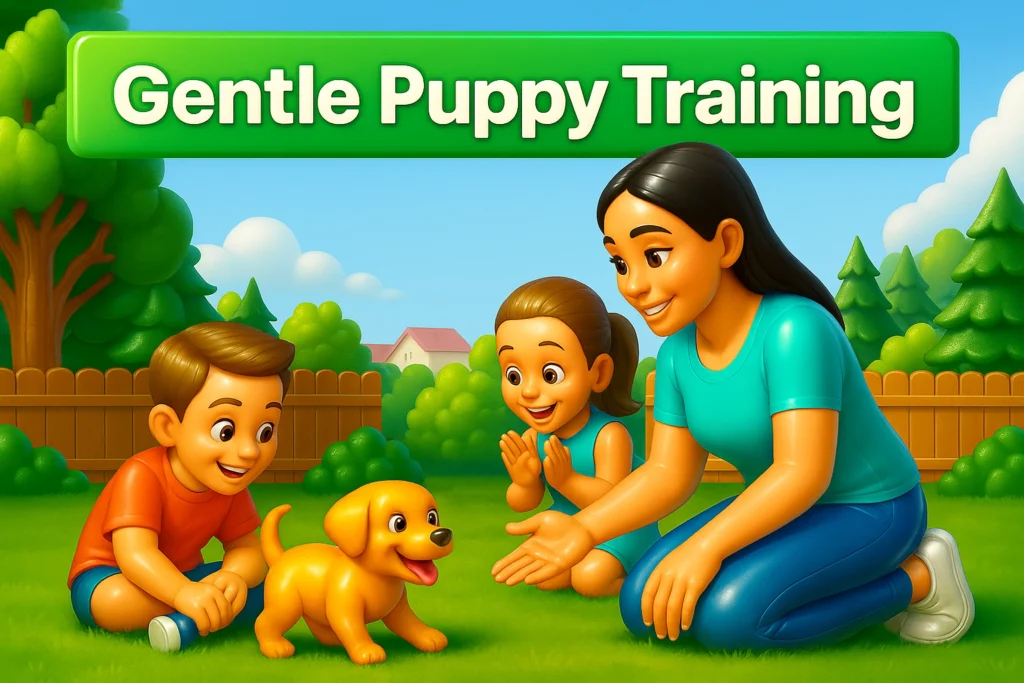
A playful puppy can bring so much joy to a family—but rough puppy behavior around kids can quickly turn fun into frustration. Puppies often jump, nip, or bark when they’re excited. But the good news? You can teach a puppy to be gentle with kids using positive reinforcement.
In this guide, you’ll learn simple, effective steps to help your puppy become a calm, kind, and kid-safe companion—all through kind training methods your whole family can use.
Why Puppies Get Rowdy Around Kids
It’s normal for puppies to be excited. Young dogs use their mouths and paws to explore the world. Understanding puppy behavior problems and solutions can help you address these natural instincts more effectively. Kids, with their high energy and small size, may accidentally encourage rough behavior without meaning to.
Your puppy isn’t being mean—just untrained. That’s why it’s so important to teach your puppy to be gentle with kids early on.
Step 1: Set Up a Calm Environment
Before training, start by setting your puppy up for success:
- Give your puppy space with a playpen or crate when things get too exciting. Learn more about effective crate training techniques to create a safe space for your puppy.
- Supervise all playtime between your puppy and children.
- Teach your kids how to behave calmly around the puppy—no yelling, chasing, or teasing.
The American Academy of Pediatrics emphasizes that young children should never be left alone with dogs, as children are three times more likely to be bitten than adults. Following proper child-dog safety guidelines protects both your child and puppy.
Positive behavior starts with structure.
Step 2: Reward Gentle Choices
Every time your puppy behaves gently around children—sitting nicely, sniffing softly, or waiting patiently—mark that behavior with praise or a clicker, and offer a small treat.
Positive reinforcement training means rewarding what you want to see more of. This approach works for all aspects of puppy training with positive reinforcement. You’re teaching your puppy, “Being calm around kids = good things happen.”
The American Veterinary Society of Animal Behavior confirms that reward-based training offers the most advantages and least harm to dogs, making it the gold standard for puppy behavior modification.
🔹 Try this:
When your child walks in the room and your puppy stays on the floor instead of jumping, say “Yes!” and give a treat. If your puppy mouths gently without pressure—praise and reward.
Over time, your puppy learns: soft, calm behavior earns attention.
Reward Gentle Choices
Teach your puppy that calm behavior gets rewarded
The Key Idea
Every time your puppy behaves gently around children—sitting nicely, sniffing softly, or waiting patiently—give them praise and a small treat. You’re teaching your puppy: “Being calm around kids = good things happen.”
⏰ Perfect Timing
Reward the gentle behavior the instant it happens. Timing is everything.
🎯 Be Specific
Reward exact behaviors you want—calm sitting, soft sniffing, patient waiting.
🔄 Stay Consistent
Every gentle interaction should be rewarded. Your puppy will learn that calm behavior gets attention.
💡 Pro Tip
Keep small treats in your pocket during family time. The faster you reward gentle behavior, the better your puppy will learn.
Step 3: Teach a “Gentle” Cue
You can teach your puppy a word like “gentle” to remind them to soften their touch. This works especially well for puppies who like to nibble hands or clothes.
Here’s how:
- Hold a treat in your closed hand.
- If your puppy licks or sniffs softly (without biting), say “Gentle” and open your hand to give the treat.
- If they nip or paw—wait. No treat.
- Repeat until they understand: gentle = treat.
Practice near your child (with supervision), using the same “gentle” cue whenever the puppy interacts calmly.
Step 4: Redirect Nipping and Jumping
Puppy play often includes biting and jumping. It’s normal—but not safe around small kids.
Rather than scolding, redirect your puppy’s energy using positive reinforcement techniques for problem behaviors:
- Keep toys nearby and offer one when your puppy starts to mouth a child’s hand.
- If your puppy jumps, ask for a ‘sit’ and reward that instead. Teaching basic commands like sit is part of a complete puppy training guide.
- Teach your child to stand like a tree (arms in, eyes away) if the puppy gets too excited.
Avoid yelling “no” or pushing the puppy down—this can make things worse. Gentle redirection is more effective.
Teaching Bite Inhibition
Help your puppy learn proper mouth control
What is Bite Inhibition?
Bite inhibition is your puppy’s ability to control the force of their bite. Puppies naturally learn this from their littermates, but they need to practice it with humans too. A puppy with good bite inhibition will mouth gently without applying pressure.
🎭 Act Like a Puppy
Yelp and withdraw when bitten too hard, just like their siblings would do.
⏸️ Stop All Play
Hard bites = immediate end to fun. This is the clearest message you can send.
🔄 Be Patient
Learning bite control takes weeks. Consistency is more important than perfection.
⚠️ Important Note
Never use physical punishment or yell aggressively. This can make biting worse and damage your relationship with your puppy. The goal is teaching, not scaring.
Step 4.5: Teach Bite Inhibition Early
Before your puppy learns to stop nipping entirely, they need to learn bite inhibition—controlling how hard they bite. This is crucial when teaching a puppy to be gentle with kids, as it’s your safety net if nipping does happen.
What is bite inhibition?
Normally, puppies learn bite pressure control from their littermates and mother. When they bite too hard during play, other puppies yelp and stop playing. Your job is to replicate this natural learning process.
Here’s how to teach bite inhibition with children:
- When your puppy mouths your child’s hand with any pressure, teach your child to say “Ouch!” in a high-pitched voice and immediately pull their hand away.
- Stop all play and attention for 10-15 seconds—just like a puppy would do.
- Resume gentle play only when your puppy approaches calmly.
- Gradually reduce tolerance for any mouth pressure over several weeks.
🔹 Try this progression:
Week 1: Only react to hard bites that would actually hurt
Week 2: React to medium pressure bites
Week 3: React to any teeth-on-skin contact
Week 4: Work toward no mouthing at all
Important: Always supervise bite inhibition training between puppies and children. Young kids (under 8) may need adult help to respond consistently.
🏆 Trainer Pro Tip:
Always reward calm behavior after your child says “Ouch!” This teaches your pup that gentleness keeps the game going. Key timing: Wait 3-5 seconds after the puppy backs off, then offer praise and a small treat.
This builds the connection between gentle mouth = continued fun. If your puppy gets more excited after the “ouch,” they may need a longer break before resuming play.
Why bite inhibition matters:
Even the gentlest adult dog may mouth during play or stress. A dog with good bite inhibition will never apply dangerous pressure, making your child safer throughout your dog’s entire life.
Practice bite inhibition training daily alongside your other gentle puppy training techniques. This foundational skill makes every other training step more effective and keeps your family safer while your puppy learns proper manners around kids.
Step 5: Practice Calm Greetings
Many puppies jump when they see someone they love. Practice greetings that reward calmness:
- Ask your child to walk up, but only pet the puppy when all four paws are on the ground.
- If your puppy jumps—have the child step back.
- When the puppy calms down, try again.
You’re teaching the puppy that calm greetings make people stay—while jumping chases them away.
Over time, your puppy will greet kids politely.
Step 6: Use Timeouts as a Last Resort
If your puppy becomes too wild or nippy, calmly guide them to a quiet area like a crate or playpen. This isn’t a punishment—it’s a reset.
After a short break (3–5 minutes), try again with a more structured activity, like a leash walk or puzzle toy. Proper leash training methods can provide excellent mental stimulation.
Timeouts help puppies learn to calm themselves.
Step 7: Be Consistent—Every Day
To teach a puppy to be gentle with kids, you need to be consistent:
- Everyone in the house should follow the same rules. This consistency is crucial for successful puppy training at home.
- Use the same cue words, like “gentle” or “sit.”
- Always reward the behavior you want—every time.
The more your puppy practices gentle play, the more natural it becomes.
Final Tip: Include Kids in the Training
Let your kids be part of the process (with supervision). Even a 5-year-old can help drop treats for calm behavior or say “gentle” at the right time.
This builds a stronger bond between child and pup—and helps both grow together. For more bonding activities, explore our guide on puppy socialization techniques.
Positive Reinforcement Builds Gentle Dogs
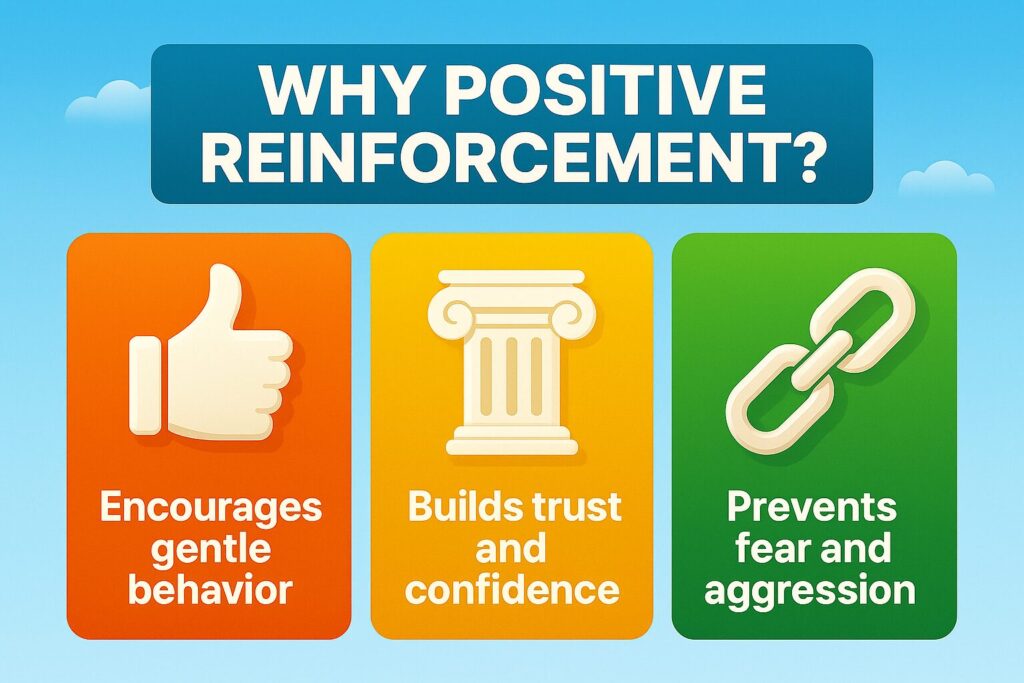
Training a puppy to be gentle with children takes time, but the results are worth it. With patience, love, and the power of positive reinforcement, your puppy can learn to play kindly and safely with every child in your home.
Start today. Set your puppy up to succeed, and raise a gentle, happy dog your whole family can enjoy.
The Psychology: Building Impulse Control and Positive Associations
The psychology behind how to teach a puppy to be gentle with kids is rooted in shaping a puppy’s emotional response and decision-making, not just suppressing their natural exuberance. Puppies are not born with self-control; it is a learned skill. This process uses operant conditioning to build neural pathways where calm behavior around children becomes more rewarding than rough play. Every time a puppy chooses to sit instead of jump, or lick instead of nip, and receives a reward, their brain learns that gentleness is the key to getting positive attention.
A critical component is teaching bite inhibition, which mimics how puppies learn boundaries from their littermates. When play stops after a hard bite, the puppy learns about cause and effect through the removal of a reward (negative punishment), not through fear. This is fundamentally different from punishment-based methods, which can create anxiety and fear around children. Instead, we are teaching the puppy to think and make a better choice.
The Key Takeaway: Changing the Picture of ‘Fun’
A child’s high energy can signal “exciting playmate” to a puppy. The core psychological shift comes from consistently redirecting this excitement and heavily reinforcing calm. Over time, the puppy’s perception changes: children are no longer seen as chaotic play partners, but as sources of predictable, gentle interaction and high-value rewards. This is why positive reinforcement builds a safe bond between puppies and kids; it changes the puppy’s underlying emotional motivation from arousal to calm connection.
By focusing on these principles, you don’t just stop bad behavior. You actively teach a puppy to be gentle with kids by building a foundation of self-control, trust, and a genuine preference for calm interactions.

Christopher Quinn adopted his first dog, Loki, a spirited Border Collie/Jack Russell mix, after exiting Army service in the summer of 2012. That experience sparked a lifelong passion for canine behavior and positive reinforcement training.
He studied Principles of Dog Training & Behavior at Penn Foster and has since worked with hundreds of dogs from all backgrounds. Over the past two years, Christopher has fostered more than 30 rescue dogs, giving each one a chance at a better life.
Today, he continues to write, teach, and share insights on humane dog training, blending hands-on experience with a decade of dedicated study.