
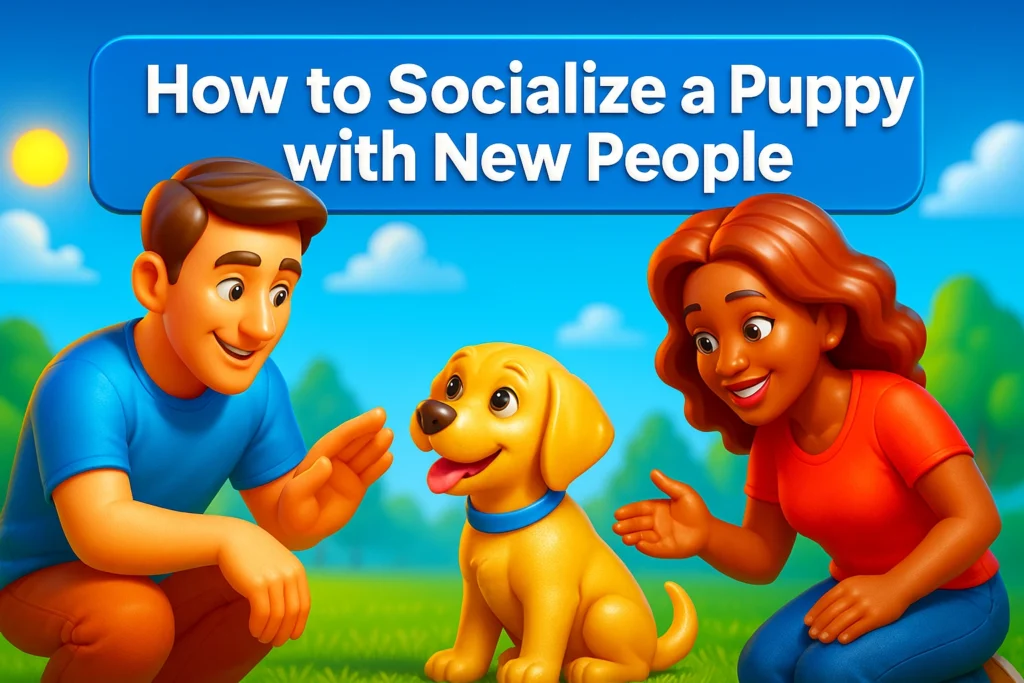
Not all puppies run up to strangers with wagging tails and playful energy. Some hide behind you. Others bark, tremble, or refuse to move.
If your puppy is shy around strangers, don’t worry—you’re not alone. Many young dogs feel nervous when meeting new people.
The good news? You can help your puppy become more confident using positive reinforcement and a patient, step-by-step plan. This guide will teach you how to socialize a shy puppy with strangers in a way that builds trust and emotional safety.
Let’s help your pup grow into a calm, friendly companion—without forcing scary situations.
Why Are Some Puppies Shy?
Puppies go through critical stages of development, and their early experiences shape how they see the world. A shy puppy may have:
- Missed out on safe socialization during the critical socialization period between 3-12 weeks of age
- Come from a less-than-ideal environment
- Experienced a frightening event involving a person
- A naturally cautious temperament (just like people!)
Whatever the cause, socialization is still possible—but it must be done carefully.
Step 1: Create a Safe Space
Before introducing strangers, make sure your puppy has a secure base—you.
At home, provide:
- A calm, quiet environment
- A crate or “puppy den” where they can retreat
- Soft bedding, gentle toys, and predictable routines
If your puppy feels safe at home, they’ll be better prepared for gentle new experiences.
Step 2: Watch Their Body Language
To socialize a shy puppy, you need to observe how they communicate fear or comfort. Learning the basics of reading your dog’s body language is essential for successful socialization.
Common signs of stress include:
- Tail tucked
- Ears pinned back
- Lip licking or yawning
- Avoiding eye contact
- Trying to flee or hide
If you see these signs during interactions, slow down. Back up to a point where your puppy feels safe again.
Learning your pup’s cues is the foundation of trust.
Advanced Pro Trainer Secrets
Insider TechniquesSocialization isn’t about getting your dog to love everyone—it’s teaching them that strangers are neutral parts of the environment, not threats.
— Sarah Chen, CCPDT-KA
Step 3: Start with Distance
Don’t bring strangers right up to your puppy. Instead, let your puppy watch people from a distance where they still feel safe.
Try sitting on a bench near a quiet sidewalk and reward calm behavior when people pass. Don’t force interactions. Just let your puppy observe.
Use a calm voice and offer small treats when your pup notices someone without reacting.
🎯 Goal: Strangers = nothing bad happens = treat = good feeling.
Step 4: Pair People with Rewards
Once your shy puppy can calmly watch strangers from a distance, you can start creating positive associations.
Ask a calm, dog-friendly person to approach—but not too close. Each time your puppy sees them, give a treat. Over time, let the person toss a treat from a few feet away.
The message becomes: “Strangers = snacks fall from the sky!”
Positive reinforcement helps rewrite fear into curiosity.
Step 5: Let the Puppy Choose
This part is crucial: Never force your puppy to interact.
Allow them to move forward if they feel brave, or retreat if they’re unsure. Forcing physical contact can make fear worse.
If a stranger wants to greet your puppy:
- Ask them to crouch sideways
- Avoid direct eye contact
- Let your puppy approach them on their own
- No reaching over the head or grabbing
Shy puppies build confidence when they feel in control.
Step 6: Use High-Value Treats
To socialize a shy puppy with strangers, ordinary kibble won’t cut it. Use special rewards:
- Boiled chicken
- Freeze-dried liver
- Tiny cheese cubes
These high-value treats are more likely to override fear and reinforce brave behavior.
Reward even tiny steps—like looking toward a stranger or taking one step forward.
Step 7: Keep Sessions Short and Positive
Shy puppy socialization is not a marathon. It’s a series of safe, bite-sized experiences.
Stick to:
- 5–10 minute outings
- One new person or location at a time
- Ending on a positive note (with treats or play)
If your puppy has a setback, that’s okay. Go back a step. Rebuild trust.
Step 8: Add Variety Slowly
As your puppy grows more confident:
- Visit parks at quiet hours
- Sit outside a pet store and people-watch
- Invite calm friends over one at a time
- Include men, women, and kids—at safe distances
Every success helps your puppy learn that the world isn’t so scary after all.
Step 9: Use a Calm Handler or Buddy Dog
Sometimes a confident dog friend can help. If your puppy sees another dog happily greeting strangers, they may be more likely to try it too.
You can also bring in a skilled trainer or calm adult to model low-stress greetings for both pup and stranger.
Just make sure the role model is truly calm—not hyper or overwhelming.
🐾 Pro Trainer Tips
- Keep sessions short and sweet. Overwhelming your puppy with too much at once can backfire. Aim for 5–10 minutes.
- Use high-value treats like boiled chicken or soft training bites—especially when strangers are involved.
- Let your puppy approach at their pace. Never force interaction. Choice builds confidence.
- Reward calm behavior around new people, even if your puppy doesn’t directly interact.
- Practice in low-distraction environments first, then gradually introduce more people, noise, or movement.
These tips are part of the PupCommand Positive Reinforcement Method—used by real foster trainers to raise emotionally balanced dogs.
Step 10: Be Patient, Not Pushy
You cannot rush emotional safety. Socialization is not about exposure alone—it’s about making the exposure positive.
Some shy puppies take weeks. Others take months. But with daily progress and patience, most dogs learn that strangers can be safe, fun, and even exciting.
Conclusion: Gentle Wins Every Time
Learning how to socialize a shy puppy with strangers means putting their emotional needs first.
With soft encouragement, treats, and total patience, your puppy will bloom. They’ll stop hiding and start engaging—with you, your friends, and the world around them.
Remember: you’re not just training a dog. You’re building trust. And trust, once earned, opens the door to a confident, loving companion for life.
The Psychology: Rewiring Fear into Confidence
The psychology of socializing a shy puppy is centered on changing their underlying emotional response, not just managing their behavior. Fear is a powerful survival instinct, often heightened during developmental fear periods. The goal is to use two core principles—desensitization and counter-conditioning—to gently rewire the puppy’s brain. Desensitization involves exposing the puppy to strangers at a distance where they feel safe, preventing the fear response from triggering in the first place.
Simultaneously, counter-conditioning works to change the association from negative to positive. By pairing the sight of a stranger with a high-value reward (like chicken), the puppy’s brain begins to form a new connection: “strangers predict amazing things.” This is why counter-conditioning works for shy dogs; it overrides the fear with an emotion of positive anticipation, making the puppy feel good in the presence of new people.
The Key Takeaway: Agency Is the Antidote to Anxiety
Forcing a shy puppy into an interaction (a technique called “flooding”) can intensify fear and erode trust. The most critical psychological component of this process is giving the puppy a sense of control. By allowing them to choose to approach, retreat, or simply observe, you empower them. This sense of agency is crucial for how letting a puppy choose builds confidence. It teaches them they can navigate the world safely and that you, their owner, are a secure base they can always return to.
By combining these gentle, science-backed methods, you are not forcing your puppy to be brave. Instead, you are creating the safe, predictable conditions under which their natural confidence can emerge and flourish.

Christopher Quinn adopted his first dog, Loki, a spirited Border Collie/Jack Russell mix, after exiting Army service in the summer of 2012. That experience sparked a lifelong passion for canine behavior and positive reinforcement training.
He studied Principles of Dog Training & Behavior at Penn Foster and has since worked with hundreds of dogs from all backgrounds. Over the past two years, Christopher has fostered more than 30 rescue dogs, giving each one a chance at a better life.
Today, he continues to write, teach, and share insights on humane dog training, blending hands-on experience with a decade of dedicated study.