
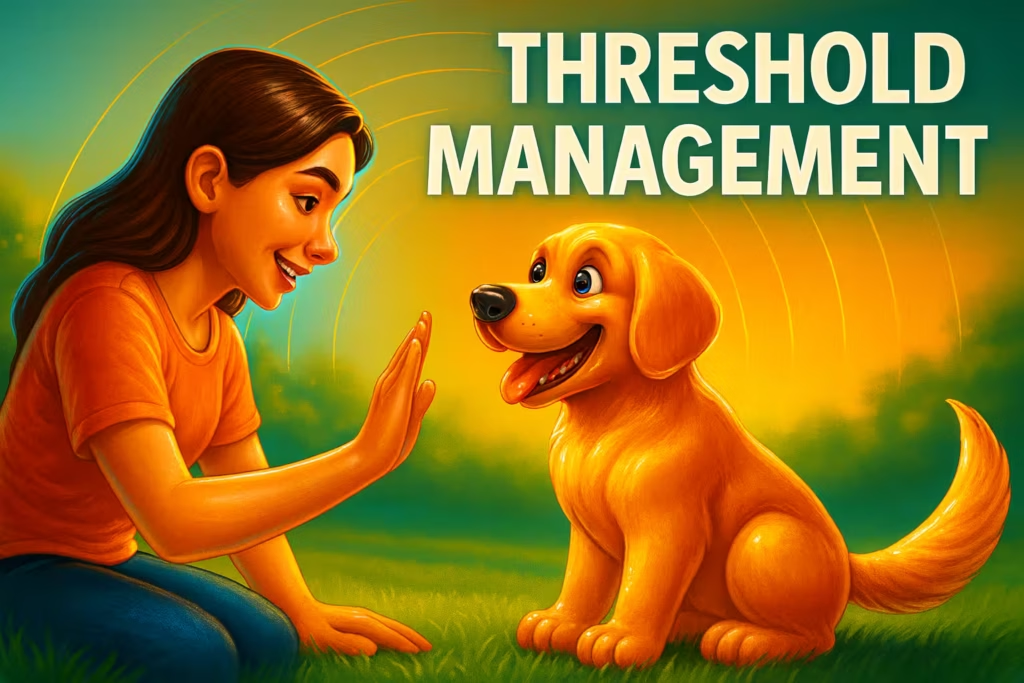
Threshold management in dog training is the skill of keeping your dog in the learning zone—calm enough to think, motivated enough to try. When dogs tip over their arousal threshold (too excited, anxious, or frustrated), attention collapses, cues get ignored, and unwanted behaviors spiral.
Stay under threshold and everything changes: your dog can focus, offer self-control, and bank confident wins. Think of it like piloting a ship—watch the gauges (body language), set distance and difficulty, and make small course corrections before alarms go off.
What is a threshold?
A “threshold” is the point where a stimulus (doorbell, other dogs, kids running, skateboards, guests, car rides) pushes your dog from workable arousal into overload. Under threshold, your dog can look at you, take food, and respond to simple cues. Over threshold, you’ll see scanning, stiff posture, lunging, barking, zoomies, or shutdown. Threshold management in dog training means tuning three dials—distance, duration, and distraction—so your dog stays in that sweet spot.
How to read the gauges: signs you’re under (or over) threshold
- Green (learning zone): soft eyes, relaxed jaw, loose tail, flexible body, takes treats, can offer a sit or hand target.
- Yellow (near threshold): still takes treats, but harder mouth, quicker movements, breathing faster, ears forward, slower response to cues.
- Red (over threshold): won’t eat, freezes or explodes, vocalizes, pupils dilated, can’t disengage from the trigger.
Your job is to catch yellow early and dial the challenge down before red.
When implementing threshold management in dog training, it’s essential to understand the connection between your pet’s physical health and behavior patterns. The Merck Veterinary Manual offers comprehensive behavior modification guidelines with insights into creating effective training protocols that respect your dog’s emotional and physical thresholds.
- Pay calm on the spot (5–8/min).
- Add gentle duration: 3–5s, then feed.
- Introduce easy novelty at distance.
The 3-D method: distance, duration, distraction
- Distance – the fastest lever. Increase space from the trigger until your dog can breathe, eat, and respond.
- Duration – keep exposures short at first: 3–5 seconds of looking, then break and reward.
- Distraction – reduce movement, noise, and novelty. Start with a still trigger, add motion only when green stays stable.
Work one “D” at a time. If you add motion (distraction), shorten duration and increase distance to keep the load balanced.
Reinforcement that builds self-control
Reinforce calm, oriented behavior: turning back to you, soft eye contact, a relaxed sit, a breathy sigh, or choosing to sniff instead of stare. Mark these moments (“Yes!” or click) and pay promptly. Use small, high-value treats at first, then mix in real-life reinforcers (access to sniffing, moving forward, saying hi) so your dog learns that self-control makes good things happen.
A simple session plan (10 minutes)
- Warm-up (1–2 min). Easy hand targets or “find it” treat tosses to prime engagement.
- Controlled exposure (5–6 min). At a workable distance, let your dog notice the trigger, then mark and reward glances or calm sits. Think: look → mark → treat → reset.
- Bank the win (1 min). Walk away to calm space; scatter a few treats in grass.
- Optional second rep (2 min). Only if your dog stayed green. End early if you see yellow creeping in.
Repeat 3–4 short sessions per week. Consistency beats marathon training.
Threshold Management in Dog Training
Keep Your Dog in the Learning Zone
Green Zone
Learning zone: soft eyes, relaxed jaw, takes treats, responds to cues. Your dog can think and learn effectively.
Yellow Zone
Near threshold: still takes treats but harder mouth, faster breathing, slower responses. Time to dial back difficulty.
Red Zone
Over threshold: won’t eat, freezes or explodes, can’t disengage. Learning stops – exit and decompress.
The 3-D Method
Distance
The fastest lever. Increase space from trigger until your dog can breathe and respond.
Duration
Keep exposures short: 3-5 seconds of looking, then break and reward success.
Distraction
Reduce movement, noise, novelty. Start still, add motion when green stays stable.
Quick Success Tips
“Look at That” and disengage games
Two fast, practical exercises anchor threshold management in dog training, often combined with counterconditioning methods to change emotional responses:
- Look at That (LAT): Let the dog look at the trigger. The moment you see a controlled look—not a hard stare—mark and feed at your leg. Over time, the trigger becomes a cue to disengage and check in with you.
- Pattern games (1-2-3 Treat, Up-Down, “find it”): Predictable reinforcement patterns lower uncertainty and smooth arousal. If a surprise appears, drop into your pattern to keep the brain online.
Release cues and pressure valves
Build a clean release cue (“free,” “break”) so your dog learns that holding a sit, settle, or heel turns the world on. Access to sniffing, greeting, or moving forward becomes part of your reinforcement economy. Pressure valves like sniff breaks, mat settles, and treat-and-train toys help bleed arousal without quitting the session.
Common mistakes (and how to avoid them)
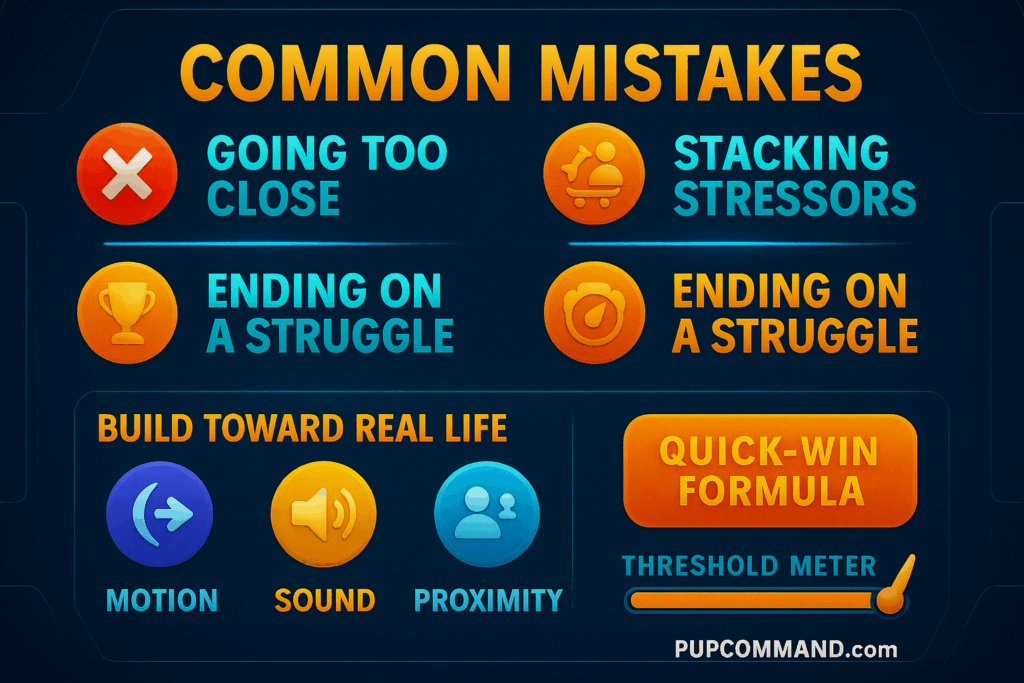
- Going too close too soon. If your dog won’t eat, you’re already over threshold. Add distance immediately.
- Stacking stressors. Two triggers at once (dog + skateboard) is a different challenge. Train one variable at a time.
- Talking too much. Keep cues short and neutral. Let the marker and food do the talking.
- Punishing arousal. Corrections can suppress signals but raise stress, pushing thresholds higher next time. Redirect into a trained pattern instead.
- Ending on a struggle. Always finish after a success, even if that means taking a big step back to green.
Building toward real life
When your dog can stay green at baseline, proof gradually using desensitization techniques to slowly increase difficulty:
- Add motion (trigger walking slowly), then sound (low noise), then proximity (a step closer).
- Change contexts: different sidewalks, parks, store parking lots.
- Vary handlers so skills aren’t attached to one person.
- Blend in functional rewards: “You looked and checked in—great, let’s walk forward,” or “Nice settle—now greet!”
Keep sessions short, successes frequent, and records simple. A one-line log—“Skateboards at 60 ft; took food; 8/10 disengages; next time try 50 ft”—helps you plan the next rep.
Threshold management for common goals
- Reactivity: Start at a distance where your dog can notice dogs without fixating. LAT + treat scatter exits help you move away gracefully.
- Excitable greeters: Teach a sit-to-say-hi ritual. The moment the sit holds, release to greet. If the sit breaks, you step back; try again—no scolding, just clarity.
- Kids & chaos: Pair kid noise with mat settles. Keep the mat far enough that your dog can stay soft-eyed and eat. Reward calm duration, then release for a brief sniff or play, and return to the mat.
- Doorways & thresholds: Approach, pause, breathe, sit, release. Doors only open for self-control.
A quick “threshold meter” you can run in your head
- Level 0–3: Calm/working. Train skills, add tiny challenges.
- Level 4–6: Near threshold. Shorten duration, add distance, pay more often.
- Level 7–10: Over threshold. Exit, decompress, and try again later with easier criteria.
This mental meter keeps you proactive instead of reactive.
Successful threshold training relies on understanding the latest developments in canine behavioral science. Professional veterinary publications provide peer-reviewed research on modern dog training methods and behavioral science that support force-free training approaches and threshold management techniques.
Why this approach works
Threshold management in dog training leverages basic learning science: arousal affects cognition. By shaping behavior under a manageable load and paying generously for self-control, you grow neural pathways for focus, resilience, and choice. Your dog learns that calm earns access, and difficult moments become solvable puzzles rather than emergencies.
By shaping behavior under a manageable load and paying generously for self-control, you grow neural pathways for focus, resilience, and choice. This approach is particularly effective for addressing behavioral issues that stem from over-arousal or anxiety. Your dog learns that calm earns access…
Put it all together
Start farther than you think, pay calmer than you feel, and quit while you’re winning. Track green/yellow/red, manipulate the 3-D controls, and let calm choices unlock life. With steady practice, threshold management in dog training transforms chaos into clarity—so your dog can think, listen, and move through the world with confidence.

Christopher Quinn adopted his first dog, Loki, a spirited Border Collie/Jack Russell mix, after exiting Army service in the summer of 2012. That experience sparked a lifelong passion for canine behavior and positive reinforcement training.
He studied Principles of Dog Training & Behavior at Penn Foster and has since worked with hundreds of dogs from all backgrounds. Over the past two years, Christopher has fostered more than 30 rescue dogs, giving each one a chance at a better life.
Today, he continues to write, teach, and share insights on humane dog training, blending hands-on experience with a decade of dedicated study.