
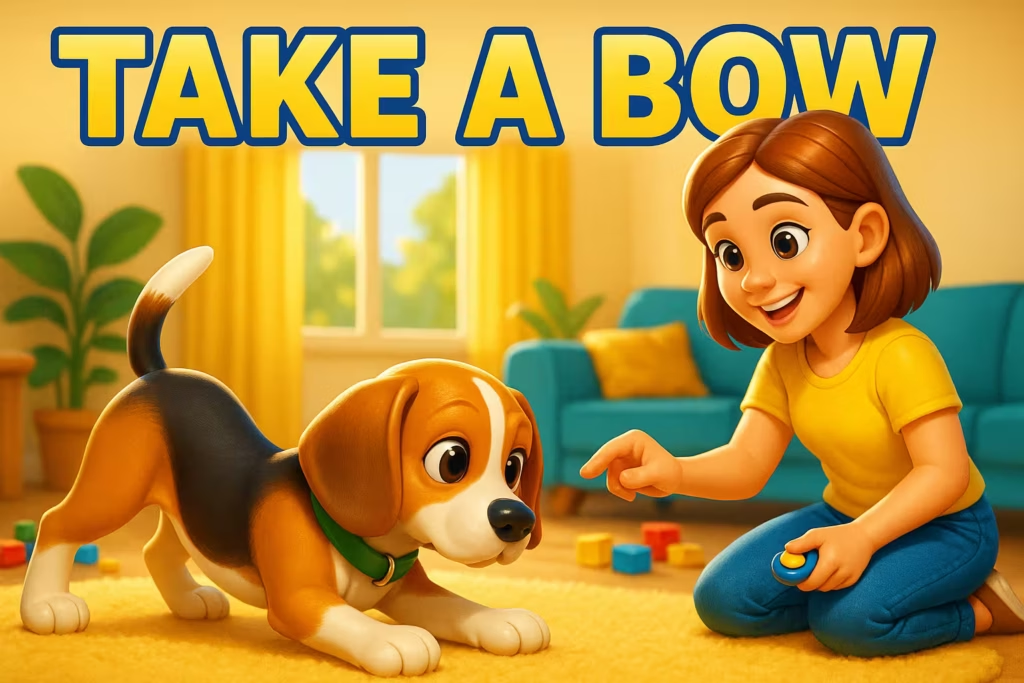
“Take a bow” is the classic front-end-down, rear-end-up pose—super cute, surprisingly useful. When you teach a dog to take a bow, it doubles as a safe stretch, helps dogs learn body awareness, and builds your reinforcement history for calm greetings.
Below is a clean, reward-based plan with several ways to teach it, plus troubleshooting, criteria ladders, and a quick practice schedule.
Teaching your dog to bow is a delightful trick that builds on basic obedience training. Before starting advanced tricks like the bow, ensure your dog has mastered fundamental commands through our complete puppy training guide for new dog owners.
What you’ll need
- Pea-sized treats your dog loves (mix of soft + crunchy is great).
- A marker (clicker or a crisp “Yes!”).
- A non-slip surface or mat.
- Optional: a book/yoga block or low platform; a target stick/your hand target.
Session tempo: 3–5 minutes, 1–2 times per day. Aim for ~6–10 quality reps, then stop while your dog still wants more.
Before you start to teach a dog to take a bow, make sure you have your dog’s favorite treats ready. High-value rewards work best for teaching new tricks. Begin with your dog standing on all four paws facing you.
Your dog should already know basic commands like ‘sit’ and ‘stay’ before learning to bow. If your pup needs work on these fundamentals, check out our guide on teaching your dog to sit first.
The American Kennel Club’s step-by-step bow training guide Teach Your Dog to Bow – American Kennel Club recommends starting by showing your dog a treat in your closed fist, then slowly moving it from their nose down to the ground between their front paws. As you do this, say “bow” in a clear, happy voice.
The behavior (what it looks like)
- Start position: standing.
- End position: elbows touch the floor/mat, chest low, hips high, knees/feet stay standing. Hold for 1–2 seconds at first, then release out of the bow back to stand.
The bow trick relies heavily on positive reinforcement techniques. For a deeper understanding of these training principles, read our comprehensive positive reinforcement dog training principles guide.
Three Positive Ways to Teach a Dog to Take a Bow
🐕 How to Train Your Dog to Bow 🎯
Professional dog training techniques using positive reinforcement methods
Dog Training Prerequisites – Basic Commands
Before starting bow training sessions, ensure your dog has mastered these essential obedience commands through positive reinforcement training:
- “Sit” command – Your dog should reliably respond to sit training
- “Stay” command – Basic impulse control and attention training
- “Down” command – Floor position training (helpful for advanced tricks)
Prepare your dog training supplies: high-value training treats, a quiet training environment, and consistent training sessions!
Lure Training Method – Teaching Dog Tricks
Begin this dog trick training with your dog in a standing position. Using the lure method, hold a training treat close to their nose, then slowly guide it down toward the ground between their front paws.
This positive dog training technique uses natural canine behavior patterns. Move the treat in a straight line downward, maintaining close proximity to their chest area to encourage the bow position naturally.
Positive Reinforcement Training – Rewarding Success
As your dog follows the training treat with their nose, their front legs should naturally lower while their rear end stays elevated. This creates the classic bow position. The moment you observe this dog behavior – even briefly – immediately apply positive reinforcement:
- Use your marker word (“Good!” or clicker training)
- Deliver the training treat immediately for effective timing
- Provide enthusiastic praise and physical affection
Remember, successful dog training rewards effort over perfection – acknowledge any attempt at front-end lowering while maintaining rear elevation!
Dog Command Training – Adding Verbal Cues
Once your dog consistently responds to the lure training and achieves the bow position, introduce your chosen verbal command. Effective dog training commands for this trick include:
- “Bow” – Clear, simple obedience command
- “Take a bow” – Complete phrase for performance training
- “Curtsy” – Alternative command for variety in dog tricks
Introduce your verbal cue just before beginning the luring motion. Consistent repetition helps your dog associate the command with the desired behavior through classical conditioning.
Advanced Dog Training – Reducing Treat Dependency
Progressive dog training involves gradually reducing reliance on food lures while maintaining learned behaviors:
- Practice the same hand signal without showing treats initially
- Minimize your physical cues and hand gestures progressively
- Transition to subtle downward hand signals only
- Eventually rely solely on verbal commands for the bow trick
Continue providing training treats as rewards when your dog performs correctly, but avoid showing them before the behavior – this develops true obedience training rather than bribery!
Duration Training – Building Impulse Control
Develop your dog’s ability to maintain the bow position through systematic duration training:
- Begin with brief holds (1-2 seconds) before reward delivery
- Gradually extend to 3-5 seconds for improved impulse control
- Introduce a release command like “Okay!” or “Free!” to end the behavior
- Only provide positive reinforcement after your release cue
If your dog breaks position early during training, simply restart the sequence without correction – positive dog training avoids punishment-based methods!
Perfecting Dog Tricks – Generalization Training
Master your dog’s bow command through comprehensive generalization and proofing training:
- Environmental training – Practice in various locations (kitchen, living room, outdoor spaces)
- Distraction proofing – Gradually introduce mild distractions during training sessions
- Handler position training – Vary your position (standing, sitting, different distances)
- Trick chaining – Combine with other dog tricks (sit, bow, shake, roll over)
Maintain short, focused training sessions (5-10 minutes) and always conclude with successful repetitions for positive association!
Successful Dog Training Complete! 🎉
🐕 Your dog has mastered the bow trick through positive reinforcement! 🏆
You’ve successfully taught this impressive dog trick using professional training methods and positive reinforcement techniques. Continue practicing regularly to maintain this learned behavior, and showcase your dog’s new obedience skills to friends and family!
Method A — Capture natural play bows (fastest for many dogs)
Great for bouncy dogs that bow during play or after naps.
- Set up the moment. Have a handful of treats ready. Keep your dog on a grippy surface. Invite a short, playful burst—toss a toy, do a little “chase me,” then pause.
- Mark the bow. The instant your dog dips the front and keeps the rear up, mark (“Yes!”) and feed 3–4 treats right where the bow happened (jackpot the first few times).
- Repeat the pattern. A few short play bursts → pause → dog bows → mark + pay. You’re telling your dog, “This pose makes the reward dispenser rain.”
- Add the cue. When the bow is predictable, say your cue as the dog starts the dip: “Bow!” (or “Take a bow!”). Mark and reinforce.
- Shift the timing. After several successes, say the cue before any motion. Pause a beat. If your dog bows, mark + feed; if not, do one play burst and try again.
Pros: very clean learning; no luring pressure.
Watch for: over-arousal. Keep play bursts tiny so your dog can focus on the mark/reward.
Practice this dog training technique for just five to ten minutes at a time to keep your dog interested and focused. Remember to reward your dog immediately when they get into the correct bow position, even if it's not perfect at first.
Expert trainers at Battersea Dogs & Cats Home explain that consistent marking and rewarding Teach your dog to take a bow | Battersea Dogs & Cats Home helps dogs learn the bow command much faster. With patience and regular practice sessions, most dogs can learn to bow on command within a week or two.
Method B — Lure from a stand (most controllable)
Perfect if your dog doesn’t offer bows on their own.
- Start in a stand. One treat at the dog’s nose.
- Draw a short “C.” Move the treat down just in front of the paws and slightly back toward the chest, like you’re drawing a tiny “C” on the floor. Keep it slow so the rear stays up.
- Mark the second elbows bend. Feed on the floor between the front paws (where you want the head).
- Release. Toss a reset treat forward to bring your dog back to standing and reset quickly.
- Repeat 5–8 reps. If your dog keeps flopping into a down, your lure went too far forward. Keep the nose close to the wrists, not between the paws.
- Add the cue. When the motion is smooth, say “Bow,” then lure. After several reps, fade the food lure to an empty hand gesture, then fade that too (see “Fading the help” below).
Pro tip: place your forearm loosely under the dog’s belly as a “soft speed bump” for two or three reps if the rear wants to collapse. No pushing—just a reminder. Swap to a yoga block/book under the belly if you prefer a hands-free prop, then fade it out.
Method C — Shape with a target/platform (great for thoughtful dogs)
This reduces sits/downs by managing body position.
- Front-feet target. Guide your dog to put front paws on a low book or foam square (reward).
- Lower the head. Mark/reward tiny head-drops toward the target surface. Keep rewards low to encourage elbows to follow.
- Catch elbow flex. When you see a hint of elbows bending, mark and feed at the lowest point.
- Grow the dip. Shape gradually to elbows touching while the back feet stay planted on the floor.
- Add cue + fade the target. Cue “Bow,” get the behavior, reward, then switch to thinner targets until you can do it on bare floor.
Pros: clear body mechanics; dogs love the “game” of shaping.
Watch for: frustration—keep increments tiny and reinforce often.
Fading the help (lures/props → independent bow)
- From food lure to hand cue: do 2–3 reps with treat at the nose, then same hand motion with empty hand, then smaller hand motion, then none.
- From prop: reduce height (book → magazine → nothing) or increase distance from the prop while still getting the bow.
- Reinforcement schedule: start 1:1, then move to “mark every bow, but jackpot the best ones.”
Short, frequent training sessions work best for teaching new tricks. For puppies especially, consider our crate training a puppy at night routine to establish good training schedules.
Add duration, distance, and a release
- Duration: once the dip is immediate on cue, start counting “one-Mississippi” in your head before marking. Build to 2–3 seconds.
- Distance: cue from standing right beside your dog, then ½ step away, then 1 step, then from in front.
- Release word: teach “free!” (or “okay!”) to end the pose. Cue Bow → 1–2 sec → mark or say “free!” and toss a treat to stand up.
Generalize & proof (make it reliable everywhere)
- Practice on three surfaces (kitchen mat, carpet, grass).
- Practice in three rooms, then the yard, then on a short leash outside.
- Vary handler position: facing your dog, at the side, kneeling, standing tall.
- Add mild distractions: toy on the floor, someone walking by at 10–15 ft, quiet sounds. Keep distance generous; success > difficulty.
🎯 Dog Bow Training Criteria Ladder
Progressive training steps for smooth dog training success
Step 1: Visual Focus Training
Your dog looks at the treat or your hand when positioned near their front paws.
If your dog shows signs of separation anxiety that interfere with training, our separation anxiety in dogs guide offers valuable solutions.
Troubleshooting
If your dog seems anxious or shuts down during training sessions, this could indicate stress. Learn more about why your dog shuts down during training and how to address it.
Dog keeps sitting or laying down.
- Your lure is too forward; keep it closer to the wrists.
- Reward earlier (first elbow bend), then ask for more depth gradually.
- Use a soft belly block (your forearm or a low book) for two or three reps to remind hips to stay up, then fade.
Dog pops back up too fast.
- You may be marking too early. Delay the mark 0.5–1 s.
- Feed two or three treats while the dog is in the bow (rapid fire).
Dog won’t bow on a slick surface.
- Switch to a grippy mat. Many dogs protect themselves on slippery floors.
Dog gets over-aroused.
- Use calmer treats, shorter sessions, and add a “reset on a mat” between reps.
- Try Method C (shaping) which feels more thoughtful than Method A.
Large/long-back breeds look uncomfortable.
- Keep duration short (½–1 s), ensure warm-up (a few slow treats and easy hand targets), and bow on soft surfaces. Skip if your vet has advised against elbows-down postures.
Add the “showtime” polish
Once your dog masters the bow, you can combine it with other tricks like teaching your dog the 'place' command to create impressive sequences.
Hand signal: a small sweeping motion of your hand toward the floor in front of the dog looks elegant on camera. Pair it with the verbal cue for a week, then try the signal alone.
Introduce distance and handler movement: step away as your dog bows; circle around; bow together (you bend at the waist while your dog bows).
Chain it with other tricks: Sit → Stand → Bow → Spin → “Ta-da!”
Keep reinforcement rich so the chain stays joyful.
Why this trick helps everyday life
- Warm-up & body comfort: gentle flexion for shoulders/neck when taught on non-slip surfaces and short holds.
- Impulse control in disguise: the dog learns to hold position for reinforcement—skills that translate to calm greetings.
- Photo-friendly “say please” alternative: you can cue Bow instead of a jumpy hello.
🗓️ 7-Day Dog Bow Training Plan
Short daily sessions for lasting results
🎉 Great Progress!
Moving to next day!
Remember that all training should focus on building a positive relationship with your dog. For more advanced techniques, explore our science behind positive reinforcement in dog training article.
Recap
- Pick your path: capture, lure, or shape.
- Mark the first elbow bend, pay at the lowest point.
- Add the cue, then fade the help.
- Build duration, distance, and generalization.
- Keep it light, short, and fun—stop while your dog wants more.
That’s it—your dog’s ready to “take a bow” like a star, and you’ll have built real, transferable training skills along the way.

Christopher Quinn adopted his first dog, Loki, a spirited Border Collie/Jack Russell mix, after exiting Army service in the summer of 2012. That experience sparked a lifelong passion for canine behavior and positive reinforcement training.
He studied Principles of Dog Training & Behavior at Penn Foster and has since worked with hundreds of dogs from all backgrounds. Over the past two years, Christopher has fostered more than 30 rescue dogs, giving each one a chance at a better life.
Today, he continues to write, teach, and share insights on humane dog training, blending hands-on experience with a decade of dedicated study.