
Family Relay Play — Indoor Recall Game for Dogs (Beginner–Intermediate)
Rotate 2–4 people as “waypoints” and call your dog in sequence. This light-energy game rapidly strengthens recall, generalization, and calm focus inside your home—perfect for busy days or bad weather.
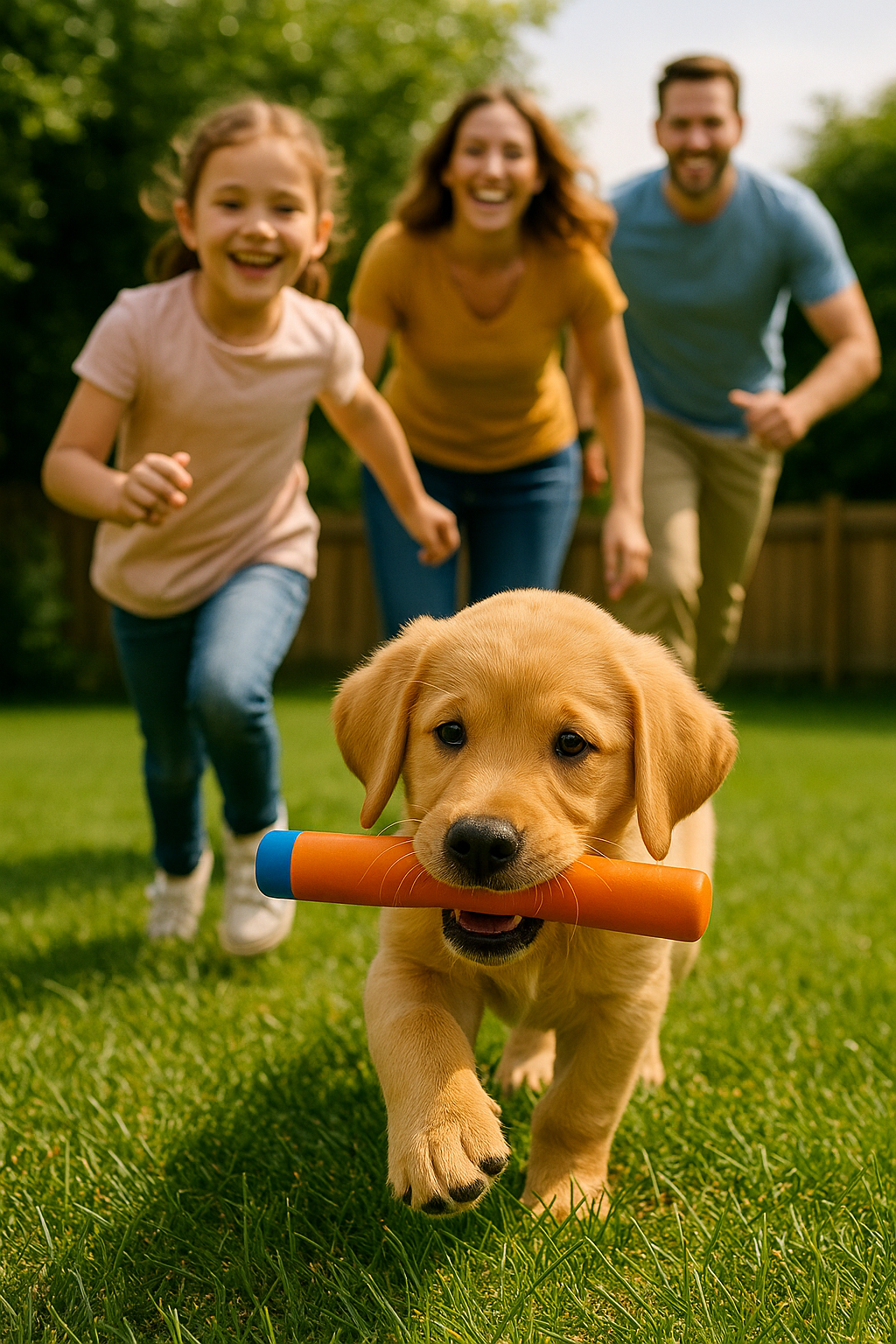
How to Run Family Relay Play (Step-by-Step)
- Stage the field. Clear a safe hallway or living room. Position 2–4 people in a loose arc or line. Keep treats or a tug toy on each person. This setup supports environmental management—fewer hazards, cleaner reps.
- One caller at a time. Person A calls the dog once in a happy tone. As the dog commits, everyone else goes quiet. On arrival, mark “Yes!” and reward. This reinforces recall per operant conditioning.
- Rotate the waypoint. Now Person B calls. Keep latency short (2–4 seconds) so momentum stays high. Alternate food and toy rewards to keep arousal balanced.
- Add a micro-behavior. After 3–4 easy reps, require a quick sit or down before payment. This builds stimulus control and channels excitement. See threshold management to prevent overload.
- Generalize. Change spacing, caller order, and room. These variations help your dog succeed around new contexts—exactly what you need for real-world recall.
Recommended Gear (Minimal)
- People: 2–4 family members or friends (the “relay”).
- Reinforcers: pea-sized treats or a short tug toy.
- Flooring: non-slip is best for confident movement.
Progressions & Variations
Beginner Track
- Short distances (6–10 ft), predictable order (A→B→C→A)
- Single behavior before payment (quick sit)
- Food rewards only for steadier arousal
Intermediate Track
- Randomized caller order; variable distances
- Mix behaviors (down, chin-target, brief eye contact)
- Alternate food and brief tug, then back to food
Want more low-setup ideas? Browse our enrichment activities catalog or jump to the Enrichment HUD to select by time, energy, and goal.
Troubleshooting (Accordion)
Dog breaks position or launches before called Over-arousal
Lower intensity: shorten distance, remove toys, and cue a sit before the call. Deliver treats low to the ground to keep movement controlled. See threshold management for red-line prevention.
Ignores the caller or drifts mid-route Cue clarity
Use one clear cue from one caller at a time. If two people speak, it muddies the contingency. Reinforce fast arrivals with high-value food; add a simple sit to earn payment for precision. Read up on shaping to sculpt clean reps.
Puppy gets zoomies or mouthy Arousal balance
Switch to food-only reps and shorten sessions to 45–60 seconds. Insert decompression (sniffing on a scatter of treats) between sets. For delicate kid interactions, see gentle with kids.
FAQ (Accordion)
How many reps should we do?
Start with 6–10 reps per set, 2–3 sets total. Keep arousal in the green by using food for most reps and sprinkling in short tug bursts.
Can I do this in small spaces?
Yes—hallways work great. Short distances plus quick rotations create many quality recall reps without chaos.
What if my dog is anxious around guests?
Start with trusted family only and widen slowly. Pair with decompression walks and controlled exposures from our anxiety guide.
Where does this fit in a complete plan?
Use Relay Play 3–4x/week alongside nosework and calm mat work. For more structured mixing, visit the Enrichment HUD.

Christopher Quinn adopted his first dog, Loki, a spirited Border Collie/Jack Russell mix, after exiting Army service in the summer of 2012. That experience sparked a lifelong passion for canine behavior and positive reinforcement training.
He studied Principles of Dog Training & Behavior at Penn Foster and has since worked with hundreds of dogs from all backgrounds. Over the past two years, Christopher has fostered more than 30 rescue dogs, giving each one a chance at a better life.
Today, he continues to write, teach, and share insights on humane dog training, blending hands-on experience with a decade of dedicated study.