
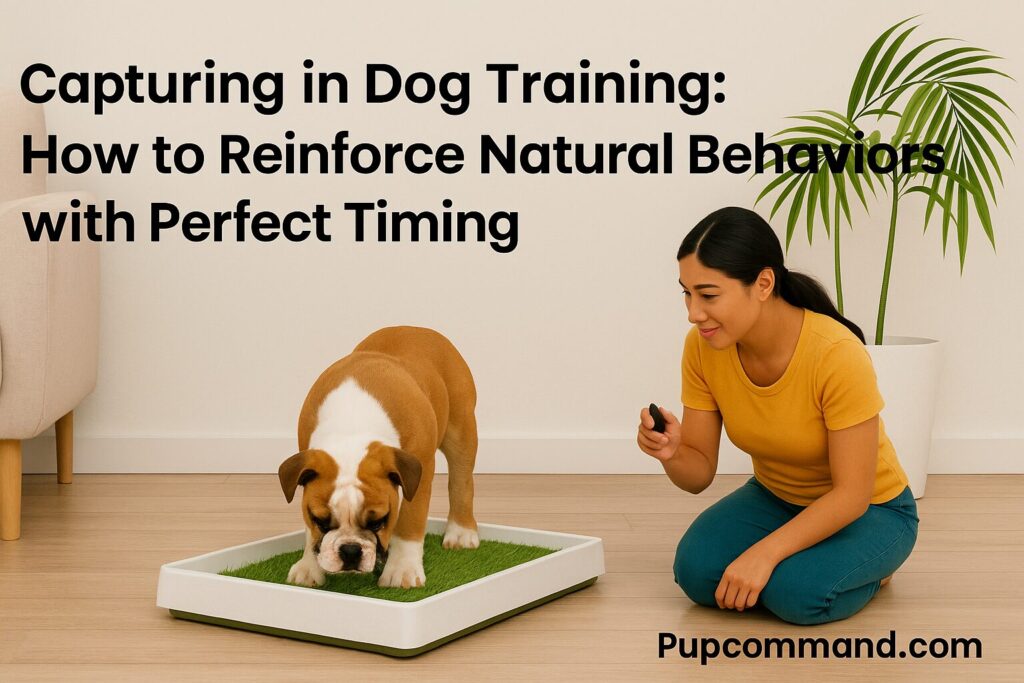
Capturing in dog training is one of the simplest, most powerful tools you can use to reinforce good behavior—without giving a cue, using lures, or prompting your dog in any way.
By waiting for your dog to offer a desired behavior naturally and then marking it, you build real-life habits based on what your dog does on their own.
This method is ideal for reinforcing calmness, attention, stretching, sitting, lying down, and other everyday behaviors you want to see more often. It’s also a confidence-building tool that helps your dog think for themselves.
In this guide, you’ll learn what capturing is, how it works, when to use it, and how it compares to other positive reinforcement techniques like luring and shaping.
What Is Capturing in Dog Training?
Capturing in dog training means waiting for your dog to naturally offer a behavior you want—without prompting or cueing—and then immediately marking and rewarding that behavior. The goal is to “catch it in the act.”
You’re not luring or guiding your dog. You’re simply watching, waiting, and reinforcing.
Real Examples of Capturing:
- Your dog lays down on their own → you click and treat
- Your dog looks at you during a walk → you mark and reward
- Your dog stretches → you capture it and eventually name it “bow”
- Your dog sits calmly instead of jumping on a guest → reward that sit
Capturing lets your dog “discover” which behaviors earn rewards. It builds engagement and initiative while reducing reliance on constant cues. For more foundational techniques like this, see our Positive Reinforcement 101 guide, which lays the groundwork for timing, rewards, and behavior shaping.
Why Use Capturing in Dog Training?
✅ Effortless reinforcement of real-life behaviors
✅ Great for calmness, attention, stillness, and relaxation
✅ Reduces micromanaging and excessive commands
✅ Strengthens the dog’s ability to make good choices on their own
✅ Deepens trust and attentiveness in training
Capturing is ideal when your dog already offers the behavior naturally—especially when it’s a behavior you want to happen more often (e.g., settling on a mat, sitting quietly during dinner, lying down at the vet).
Capturing complements techniques like clicker training and shaping, both of which are valuable in teaching new or more complex behaviors.
How Capturing Works: Step-by-Step
✅ Step 1: Identify the Behavior You Want to Capture
Start with behaviors your dog already does—especially when they’re calm or in their routine. Common first targets include:
- Lying down
- Sitting
- Looking at you
- Going to a specific place
- Yawning or stretching
- Standing calmly while being brushed
✅ Step 2: Prepare Your Marker and Reward
Use a clicker or verbal marker like “Yes!”
Keep high-value treats handy—either in your pocket or a pouch. You need to mark immediately and reward within 1–2 seconds.
✅ Step 3: Watch and Wait
This is the hard part—don’t say anything. Just observe.
As soon as your dog offers the behavior, mark the moment it begins (not after it’s over), and deliver a treat.
Example:
Dog lays down → click or “Yes!” → treat → reset
✅ Step 4: Repeat and Reinforce
After a few repetitions, your dog will start offering the behavior more frequently. Once it’s consistent, you can start adding a cue if you want.
But remember: the magic of capturing is in not asking. You’re reinforcing what they do on their own.
Capturing vs. Luring vs. Shaping
| Technique | Description | Best For |
|---|---|---|
| Capturing | Rewarding natural behavior when it happens | Calmness, attention, stretches |
| Luring | Using a treat to guide the dog into position | Teaching body positions like “sit” |
| Shaping | Rewarding small approximations toward a complex behavior | Advanced or multi-step tricks |
Capturing in dog training is the least intrusive and most organic method—it allows dogs to think and choose behaviors independently.
When to Use Capturing in Daily Life
✅ Reinforce calmness: Catch your dog relaxing quietly instead of barking or pacing
✅ Teach “Go to Your Spot”: Wait for your dog to go to their mat or bed and mark that moment
✅ Improve leash walking: Capture voluntary check-ins or loose leash behavior
✅ Vet prep: Capture lying still for grooming, paw handling, or body checks
✅ Impulse control: Reinforce moments of self-restraint—like sitting instead of jumping
🟢 Support leash manners further by combining capturing with desensitization to unfamiliar stimuli like passing cars, strangers, or squirrels.
Over time, capturing builds an automatic behavior repertoire—your dog does good things not because you said so, but because it pays off.
Tips for Effective Capturing
- 🎯 Always mark the start of the behavior, not the end
- 🕒 Timing is everything—click late, and your dog may associate the reward with the wrong behavior
- 🔇 Don’t cue or speak—let your dog lead
- 🧠 Keep sessions short and positive
- 🧺 Have treats ready in multiple spots around the house so you’re always prepared to reinforce spontaneously
If your dog struggles with fear or overstimulation, use counterconditioning techniques to ease emotional reactivity before relying on capturing.
Common Mistakes to Avoid
❌ Talking or giving hand signals before the behavior
❌ Marking too late (after the behavior is over)
❌ Rewarding without marking—this reduces clarity
❌ Expecting too much too fast
❌ Capturing unwanted behaviors (like barking) by accident
Capturing in dog training works best when you stay neutral, patient, and reward only the behaviors you truly want repeated.
Real-Life Capturing Scenario: Reinforcing Settle Behavior
- You’re working at your desk
- Your dog lays down near you calmly
- You quietly click and toss a treat
- A few minutes later, they lay down again—click and reward
- Within days, your dog starts offering that “settle” behavior more often
- You’ve just taught “calm by default” without a single cue
That’s the power of capturing.
When to Add a Cue
Once your dog consistently offers the behavior, you can name it:
- Dog stretches → say “bow” as they do it → click and reward
- Dog lays down → say “settle” → click and reward
- Dog looks at you → say “focus” → click and reward
After enough repetitions, your dog will associate the cue with the behavior and offer it on command.
Capturing is grounded in modern, science-based training philosophy. In fact, the American Veterinary Society of Animal Behavior strongly endorses positive reinforcement methods as the most effective and humane way to shape behavior—especially when encouraging calmness, attention, and emotional stability.
Frequently Asked Questions: Capturing in Dog Training
1. What is capturing in dog training, and how does it work?
Capturing in dog training involves rewarding your dog at the exact moment they perform a desired behavior naturally, without you giving a command. It’s one of the cleanest ways to build habits like calmness, attentiveness, or stretching. You simply observe, mark the behavior (e.g., with a clicker or verbal “Yes!”), and reward.
2. Can capturing in dog training help with everyday behavior?
Absolutely. Capturing in dog training is perfect for reinforcing manners like sitting instead of jumping, lying down during meals, or calmly walking to a mat. Over time, these behaviors become habits—because they pay off. It’s especially useful for reinforcing behaviors you want your puppy to do by default, such as settling at night. For more structured nighttime routines, refer to our puppy nighttime settling guide.
3. What should I do if my dog isn’t offering any behaviors to capture?
If nothing’s happening, the environment may be too stimulating—or your dog might need rest. Start in a low-distraction space. You can use tools like desensitization to gradually reduce reactivity in hyper-alert dogs before capturing calmer moments.
4. Is capturing in dog training suitable for fearful or anxious dogs?
Yes, but it must be paired with emotional safety. If your dog is fearful, capturing calm moments can be powerful, but never force them into position. Let the behavior emerge naturally. For dogs that startle easily, consider layering in counterconditioning before beginning a capturing routine.
5. Can I use capturing in dog training with older dogs?
Definitely. Older dogs may offer calm behaviors more consistently than puppies, making them ideal candidates for capturing. Reinforcing natural stillness during vet prep or quiet times at home is a great way to reduce stress. If your older dog also needs help adjusting to household structure, try layering capturing with positive reinforcement puppy training techniques that apply at any age.
Final Thoughts: Capturing Builds Habits and Trust
Capturing in dog training teaches your dog that good things happen when they make good choices—without being told what to do. It’s a subtle but powerful technique that helps dogs feel more confident, independent, and relaxed in your presence.
Whether you’re reinforcing calmness at home, attention on walks, or polite behavior around guests, capturing turns everyday moments into powerful learning opportunities.
Explore our complete puppy training guide to see how capturing fits into a full behavioral development plan.
Ready to try capturing in your dog training sessions?
Start small. Watch for a quiet sit, a glance, or a gentle lay-down—and reward it. Your dog will thank you with even more of the behavior you love.