
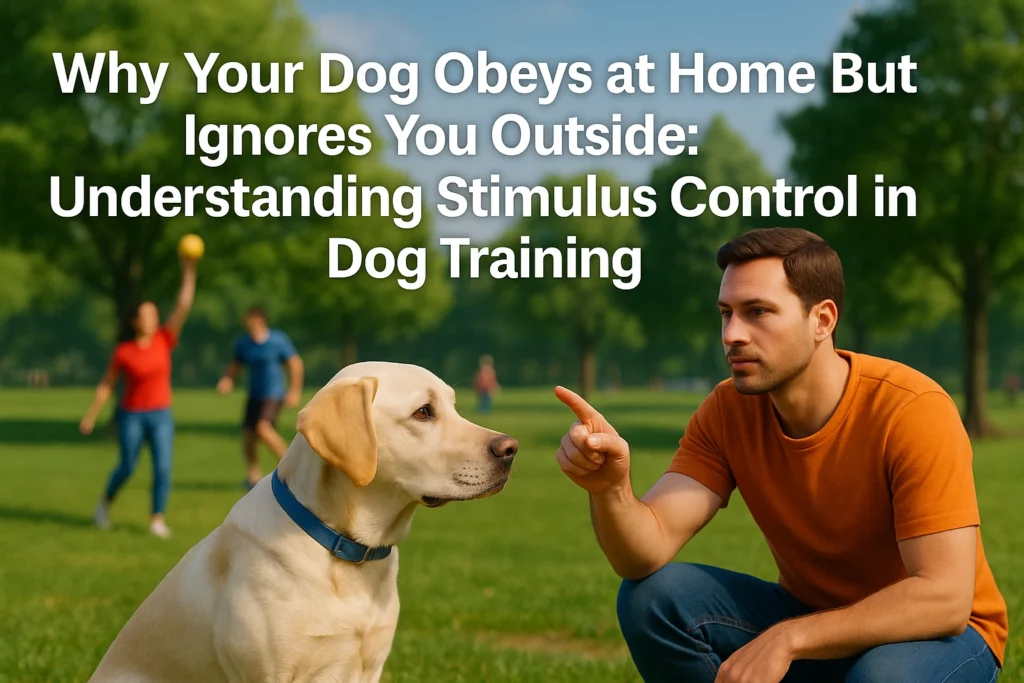
Imagine this: your dog sits perfectly in the kitchen, responds instantly to “come,” and waits politely at the door. But the moment you step outside? They act like they’ve never heard a command in their life. Sound familiar? You’re not alone—and the problem isn’t your dog’s stubbornness.
It’s a concept in behavioral science called stimulus control.
In this article, we’ll break down why your dog obeys at home but ignores you outside, what stimulus control in dog training actually means, and how to fix this frustrating issue using positive reinforcement and consistency.
✅ What Is Stimulus Control in Dog Training?
Stimulus control in dog training refers to your dog’s ability to perform a specific behavior only when a specific cue is present—and not when it’s not. In other words, a cue like “sit” should only result in a sit if:
- The dog hears the correct command (not random noise)
- The behavior happens immediately
- The dog doesn’t offer the behavior without the cue
- The dog doesn’t respond to a different cue the same way
This concept builds directly on classical conditioning principles where dogs learn to associate specific environmental cues with expected behaviors and outcomes. When your dog sits every time you say “sit” at home but ignores you outside, it means the stimulus control hasn’t transferred to the outdoor environment.
Recent stimulus control research and behavioral training studies published in peer-reviewed journals demonstrate how environmental cues directly impact canine response reliability, confirming what professional dog trainers have observed for decades.
🐕 Stimulus Control in Dog Training
🎯 What is Stimulus Control?
Stimulus control in dog training is the foundation of reliable obedience. It occurs when a dog consistently responds to a specific cue or command in a predictable manner, regardless of distractions or environmental changes. Perfect stimulus control means your dog performs the behavior only when asked and stops when released.
💡 Essential Training Tips
🧠 Why Dogs Obey in the Living Room but Not on a Walk
This happens for a few core reasons:
1. Distractions Break Focus
The outdoors are full of competing stimuli: squirrels, smells, cars, other dogs, and people. If you haven’t practiced obedience in gradually increasing distraction levels, your dog isn’t ignoring you—they’re overwhelmed.
2. Lack of Generalization
Dogs don’t automatically apply what they learn in one place to another. Just because your dog understands “down” in the living room doesn’t mean they understand it on the sidewalk, in a park, or near traffic. That’s a failure to generalize behavior across environments.
3. Poor Reinforcement History
At home, your dog gets rewarded consistently. Outside? You might not reward at all, or you might raise your voice, get frustrated, or repeat cues. That inconsistency teaches your dog that commands aren’t always worth responding to.
These inconsistencies are among the most common dog behavior problems and solutions that professional trainers address, and they stem from incomplete stimulus control training.
🚧 Signs Your Dog’s Behavior Isn’t Under Stimulus Control
Here’s how to tell if stimulus control hasn’t been established:
- Your dog only responds in certain rooms or situations
- You need to repeat cues multiple times
- Your dog performs the behavior randomly, even when you didn’t ask
- The cue doesn’t work when you’re outside, around people, or at the vet
These are common symptoms of poor stimulus control in dog training, and they’re fixable with a clear plan.
🔁 How to Build Reliable Obedience Everywhere
1. Train in Multiple Environments
Start with your dog’s strongest command (like “sit” or “touch”). Practice it in the kitchen, then the hallway, then the yard, then the front sidewalk. The goal is to train the cue in at least 5+ different environments, increasing distractions gradually.
This systematic approach to environmental dog training management ensures your dog learns that commands apply everywhere, not just in familiar spaces.
2. Use High-Value Rewards Outside
In a distracting environment, a regular treat may not cut it. Use high-value reinforcers like chicken, cheese, or tug toys when working outside. Match the level of distraction with the quality of reward.
3. Keep Sessions Short and Successful
Don’t expect perfect behavior right away. Aim for micro-wins—one correct sit at the park is more powerful than 10 ignored commands. Build up your dog’s success rate gradually.
4. Re-teach Commands with the Same Clarity
Don’t just assume your dog “knows it.” Use the same training steps you used indoors:
- Lure the behavior
- Mark with a click or “yes”
- Reward
- Add the verbal cue after a few repetitions
You’re not starting over—you’re simply reinstalling stimulus control in a new context. This process of gradually building complexity is called shaping dog behaviors systematically, and it’s the most reliable way to achieve consistent stimulus control across all situations.
🎓 Professional Trainer Tips
These proven techniques are used by professional dog trainers worldwide to achieve faster, more reliable results with dogs of all ages and breeds.
⭐ Expert Training Strategies
🔁 Bonus: Practice with Distraction Games
Training your dog to obey outdoors also means helping them learn to filter distractions. Try games like:
- Find it: Toss treats into the grass and let your dog sniff them out (focus builder)
- Name game: Say your dog’s name and reward eye contact
- Red light/green light: Walk, stop, and cue a sit. Reward when your dog stops with you.
These games improve focus and reinforce the idea that you’re worth paying attention to, even when the world is exciting.
Leading animal behaviorists, including those who follow Karen Pryor’s positive reinforcement dog training methods, emphasize that true stimulus control requires systematic practice across multiple contexts to achieve consistent obedience commands.
🧭 Your Next Steps: Building Real-World Reliability
Stimulus control in dog training doesn’t happen by accident. It’s built intentionally, over time, through repetition, clarity, and positive reinforcement. If your dog ignores commands outside but listens perfectly at home, don’t give up—just shift your strategy.
Here’s your action plan:
- Pick 1 cue your dog knows well
- Practice it in 3–5 new environments this week
- Use high-value rewards
- Keep sessions short and end on success
With time, your dog will begin to understand that commands matter everywhere—not just indoors.
📌 Final Word
Your dog isn’t being stubborn. They’re not testing you. They simply don’t yet know that “sit” means the same thing on a busy sidewalk as it does on the living room rug. Stimulus control is the key to unlocking consistent, reliable obedience—and now you know exactly how to build it.