
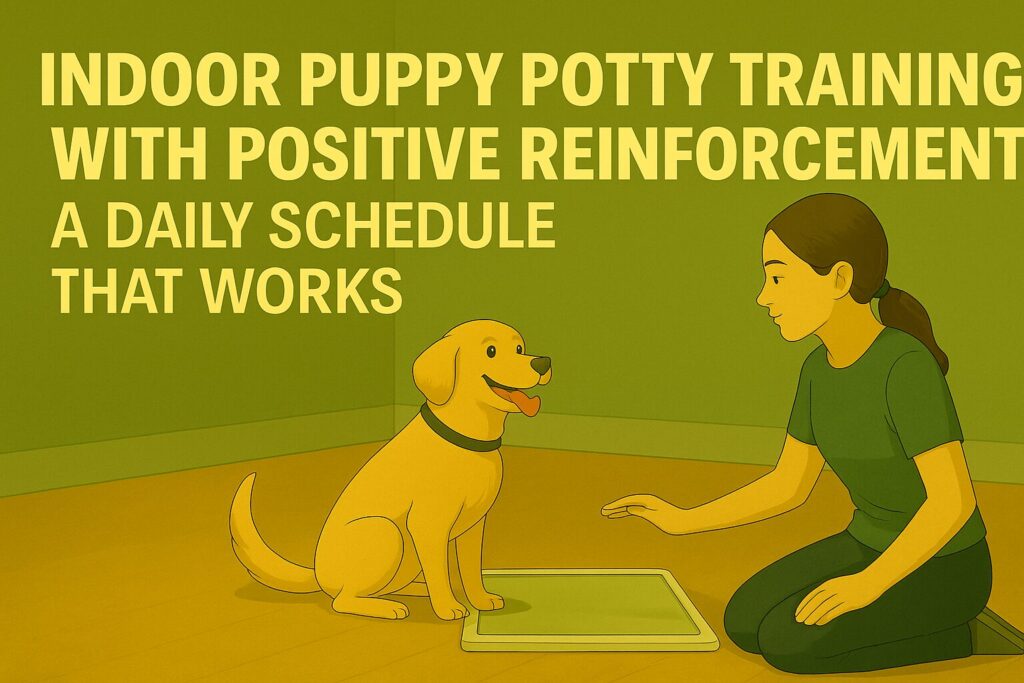
Indoor puppy potty training with positive reinforcement schedule is:
The ideal solution for dog owners who can’t always make it outside!
Whether you live in an apartment, face bad weather, or are caring for a very young pup.
This method combines structure, science, and simplicity. No yelling. No punishment. Just clear expectations and calm rewards.
In this guide, you’ll learn how to build the perfect indoor potty routine, fix common mistakes, and gently shape your puppy into a confident, house-trained companion. This indoor puppy house training with positive reinforcement approach works particularly well for apartment puppy potty training situations where outdoor access is limited.
Indoor puppy potty training with positive reinforcement is the gold standard for modern dog training. Unlike traditional methods that rely on punishment, this approach builds trust between you and your puppy while creating lasting behavioral changes.
Why Indoor Potty Training Needs a Precise Schedule
Indoor dog potty training is not a fallback. It’s a dedicated puppy bathroom training method with its own rules that works for small breed puppy potty training and larger dogs alike.
The key to successful indoor puppy potty training with positive reinforcement lies in understanding your puppy’s natural rhythms. When you work with your puppy’s instincts rather than against them, results come faster and with less stress for everyone involved.
Indoor training is not a fallback. It’s a dedicated method with its own rules.
You’re not just teaching “don’t pee on the rug.” You’re teaching:
✔️ This spot = yes.
❌ Every other spot = not yet.
Without a consistent potty schedule:
- Puppies guess (wrongly)
- Habits form slowly
- Accidents become normalized
But with a structure? Results come fast—and stress melts away.
Tools You’ll Need for Indoor Puppy Potty Training with Positive Reinforcement
These indoor potty training supplies will make your puppy housebreaking with positive reinforcement job smoother and your puppy’s success more likely:
- 🟩 Absorbent potty pads or turf patches in trays
- 🐾 Enzymatic cleaner to remove all traces of scent
- 🎯 High-value crate training treats (tiny, soft, exciting)
- ⏱️ Timer or phone alerts for breaks
- 🛎️ Optional: bell for potty signal training
- 🛑Crate or pen to limit free-roam time during training phase – learn more about how to potty train a puppy in an apartment for space-limited situations
Having the right supplies makes indoor puppy potty training with positive reinforcement much more manageable. Quality tools reduce frustration and help you stay consistent with your training approach.
Step-by-Step Daily Indoor Potty Training Schedule (8–12 Weeks)
This positive reinforcement potty training schedule works with your puppy’s bladder development and meal timing, making it ideal for 8 week old puppy potty training and older pups.
🕖 7:00 AM – Wake & Potty
- Carry your puppy directly to the pad – this is especially important if you’re teaching your puppy to stay in designated areas.
- Use a cue like “Go potty.”
- When they go: praise immediately and deliver the treat within 2 seconds. This reward-based potty training technique is the cornerstone of successful indoor puppy training.
✅ This first success sets the tone for the day.
🥣 7:15 AM – Breakfast
- Puppies often need to go again 10–20 minutes after eating.
- Set a timer to bring them back to the pad.
This schedule works with your puppy’s bladder development and meal timing, building on essential puppy training basics.
🔁 Every 60–90 Minutes
- Don’t wait for “signs”—be proactive with your puppy potty training routine. This consistent potty training schedule prevents accidents before they happen.
- Escort your puppy to the pad every hour, reward success.
- Avoid play until after potty to reduce distractions.
💤 After Every Nap
- Always take them to the pad immediately after waking.
- Reward if successful.
- If not, try again in 10 minutes.
🧠 12:00 PM – Lunch → Potty
- Repeat the breakfast routine.
- Puppies’ digestion is fast. Miss this window, and accidents follow.
🕓 3:00 PM – Afternoon Reset
- Another walk to the pad.
- Keep play supervised between now and dinner.
🍽️ 6:00 PM – Dinner → Potty
- Last meal of the day.
- Helps reduce overnight elimination needs.
🌙 8:30 PM – Final Potty
- No excitement. Just calm potty cue, success, reward.
- Then into crate or sleep space.
⏰ Optional 2:00 AM Potty Trip
- For puppies under 12 weeks, consider a nighttime potty break.
- Keep it low energy: no play, just business.
If you’re struggling with consistency, remember that Indoor Puppy Potty Training with Positive Reinforcement requires patience and structure.
Many new owners abandon Indoor Puppy Potty Training with Positive Reinforcement too early, mistaking normal accidents for failure.
Why This Schedule Works
- 🕰️ Predictability builds trust
- 💬 Cue + reward makes the right behavior obvious
- 🛑 Interrupts eliminate bad patterns early
- 🔁 Repetition accelerates success
A good indoor puppy potty training with positive reinforcement schedule feels boring—and that’s what makes it effective for fast puppy potty training results.
How to Reinforce Pad Use Correctly
The positive reinforcement reward for puppy pad training success has to be:
- Immediate
- Consistent
- Special (high-value treats only used for potty)
✨ Pro tip: Say a verbal cue right as your puppy finishes. Example: “Yes!” or “Good potty!” This starts building verbal pairing.
Then give your treat within 1–2 seconds of completion.
What to Do When Accidents Happen
They will. And they’re not failures—they’re feedback. Remember, positive reinforcement for problem behavior is always more effective than punishment.
Here’s the potty training accident recovery protocol for indoor puppy housebreaking:
- ❌ Do not punish
- ✅ Interrupt calmly (“Oops!”) and move pup to pad
- 🧼 Clean with enzymatic spray—not bleach or vinegar
- 🔁 Adjust timing: if an accident occurred 10 minutes after play, shorten your potty interval
If your pup pees in the same spot twice (not the pad), block access to that area with a gate or box.
How to Train a Potty Signal (Bell Method)
Want your dog to ask when it’s time to go? Puppy potty training with bell method combined with positive reinforcement indoor training creates clear communication.
Bell training can work for pads too:
- Hang a bell near the potty pad
- Tap it with your puppy’s paw before every scheduled potty trip
- Reward potty success—not bell ringing
- After 3–4 days, your pup will start ringing it to alert you
This boosts independence and helps long-term communication—even if you transition outdoors later. For more advanced training, check out our guide on how to teach your dog the place command.
Transitioning From Pads to Outdoors
Yes, indoor puppy potty training with positive reinforcement schedule can transition to outdoor potty training seamlessly with gradual potty training transition methods.
- ✅ Move the pad closer to the door once indoor habits are consistent
- ✅ Start using a leash to guide to the pad
- ✅ Eventually replace pad with turf patch outside
- ✅ Begin rewarding outdoor success only
Never ‘shock switch’ your pup from pad to yard. Phasing is key, just like with crate training a puppy step by step.
Real-Life Example: Sophie the Yorkie
Sophie, a 9-week-old Yorkie in a fourth-floor apartment, started pad training on day one. Her owner:
- Took her to the pad 12x per day
- Used liver treats only for potty success
- Added a bell after 4 days
In 11 days, Sophie was 100% reliable on the pad and had begun ringing the bell unprompted.
After 4 weeks, the pad was moved to the balcony. By week 6, she was pottying outside full-time.
Sophie’s success demonstrates why indoor puppy potty training with positive reinforcement works so effectively. Her owner’s consistency with the reward-based approach made all the difference in achieving quick results.
📈 It works—when you stick to the structure.
According to the American Kennel Club, rewarding indoor potty habits consistently and supervising during free-roam time are key to preventing regression.
Frequently Asked Questions
Q: Will indoor potty training confuse my dog later?
Not if you clearly mark the transition. Indoor to outdoor potty training works best when you maintain the same positive reinforcement training methods.
Q: My puppy pees right next to the pad. What now?
Try using a larger pad, or add a border like a tray to create a clearer physical boundary.
Q: Should I scold for accidents?
No. It only teaches fear—and fear delays learning. Ignore mistakes. Celebrate success.
Q: How long does it take to fully potty train indoors?
2–4 weeks for solid routines. 6–8 weeks for near-flawless behavior with consistent practice.
Final Thoughts
When used properly, an indoor puppy potty training with positive reinforcement schedule helps your dog thrive with stress-free potty training and humane dog training methods
You don’t need to yell. You don’t need to guess. You just need to stick to the plan. For more comprehensive guidance, explore our complete puppy training guide for new dog owners.
🎯 If you want a printable tracker, bell training walkthrough, and sample reward chart—click here to download our Indoor Potty Training Toolkit

Christopher Quinn adopted his first dog, Loki, a spirited Border Collie/Jack Russell mix, after exiting Army service in the summer of 2012. That experience sparked a lifelong passion for canine behavior and positive reinforcement training.
He studied Principles of Dog Training & Behavior at Penn Foster and has since worked with hundreds of dogs from all backgrounds. Over the past two years, Christopher has fostered more than 30 rescue dogs, giving each one a chance at a better life.
Today, he continues to write, teach, and share insights on humane dog training, blending hands-on experience with a decade of dedicated study.