
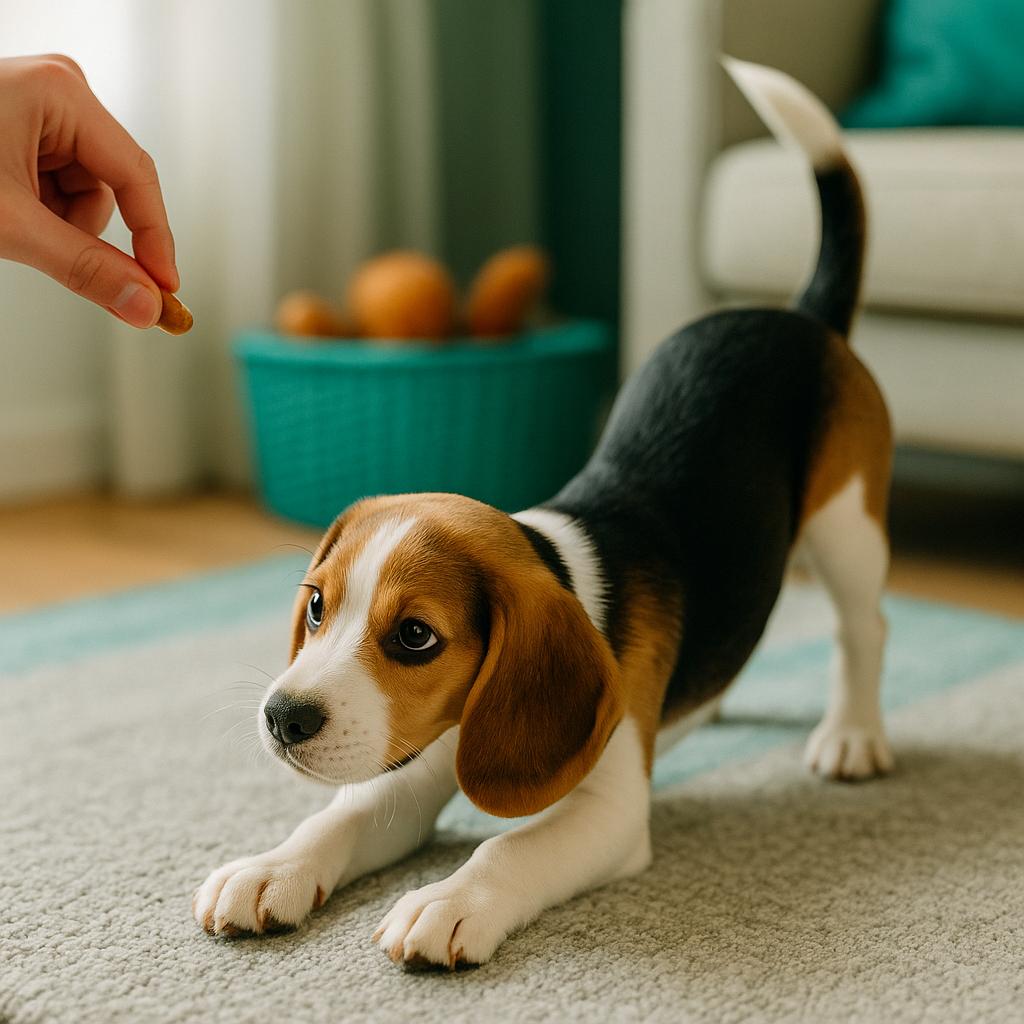
Teach a Dog to Spin and Bow
An evidence-based trick sequence that refines coordination, sharpens focus, and deepens your training relationship.
This guide moves beyond a simple how-to. You’ll set clear criteria, layer stimulus control, and then chain the behaviors into a compact routine. The process is efficient, humane, and repeatable across contexts.
Step-by-Step: How to Teach a Dog to Spin and Bow
Part 1: Teaching the “Spin”
- Preparation: Choose a non-slip surface and high-value reinforcers. Keep sessions brief to protect motivation.
- Lure with clean mechanics: Move the food lure in a continuous arc so the head leads the body. Smooth arcs produce cleaner rotations.
- Mark on completion: Capture the instant the hindquarters realign. Accurate timing clarifies the criterion for the next rep.
- Fade prompts: Shift to an empty-hand lure, then a small circular finger cue. Reinforce only responses to the smaller cue.
Part 2: Teaching the “Bow”
- Set the posture: Begin from a balanced stand. Guide the lure toward the sternum, not the floor, so elbows descend while hips stay up.
- Reinforce the descent: Mark elbow contact. If the dog collapses into a down, reset criteria and rebuild in smaller slices.
- Add brief duration: Hold one to two seconds before reinforcement. This stabilizes posture without creating friction.
- Fade to a gesture: Replace food with a downward palm cue. Pair a verbal cue only after the behavior is consistent.
Part 3: Chain the Combo
- Verify fluency: Aim for low latency and ≥80% success per context. If needed, review shaping in dog training to split criteria and thin prompts.
- Forward chain: Cue spin and immediately cue bow as rotation finishes. Reinforce the final behavior to stabilize the sequence.
- Introduce a sequence cue: When reliable, add “Showtime!” before the first gesture. Reinforce generously so the dog values completion.
- Balance directions: Train both spin directions to improve symmetry and reduce overuse risk.
Why Teaching Spin and Bow Is Important
Trick training feeds cognitive needs that routine walks may miss. Short, structured sessions reduce frustration, channel energy, and create predictable reinforcement patterns that lower stress. If you’re building confidence in new places or around unfamiliar sights and sounds, the Puppy Socialization Tool helps plan calm exposures.
The movements carry physical value. A tidy spin builds balance and body awareness, while a controlled bow engages shoulders and core. Families can also layer life skills—such as respectful interactions—using guides like teach a puppy to be gentle with kids.
Some teams start in a brand-new household. To keep sessions smooth during transitions, see strategies to help a new puppy adjust to your home, then introduce this trick as a brief, predictable routine.
The Science Behind Spin and Bow
You begin with operant conditioning: luring to prototype the posture, then shaping to refine form. The cue becomes the discriminative stimulus that signals reinforcement is available for that specific response.
Early sessions run on a continuous schedule to build clarity. As behavior stabilizes, shift to a variable ratio schedule to strengthen persistence. Keep criteria jumps small to avoid ratio strain and maintain enthusiasm.
Components of a Successful Trick
Hover or focus a bar to highlight.
Spin and Bow Training Plan
Week 1: Criteria and Mechanics
Establish crisp hand paths and minimal latency. Reinforce complete rotations and true elbow contact. Track success rate per five-rep block, advancing criteria only at ≥80% success to protect clarity.
Week 2: Cue Transfer and Generalization
Fade food to empty-hand gestures and introduce verbals. Change rooms and flooring to generalize. Add modest distractions. If precision dips, reduce difficulty or increase payoff to restore quality.
Week 3: Chaining and Reinforcement
Implement a forward chain, reinforcing at the end of the bow. Use a variable schedule to sustain momentum. Add a new sequence cue (like “Showtime!”) once the chain runs smoothly.
Advanced Tips & Proofing
Proofing: Alter one variable at a time—handler position, distance, or mild environmental noise. If accuracy dips, step back and rebuild.
Competing motivators: Pre-session decompression and high-value reinforcers curb sniffing. When arousal spikes, insert a brief pattern game. Smart environmental management protects footing and focus.
Stimulus control: The cue should evoke the behavior, and its absence should not. If you see guessing, tighten timing and criteria.
Symmetry and longevity: Alternate spin directions and keep bows compact. Prioritize form over speed to protect joints, especially on slick floors.
Troubleshooting Common Challenges
Adjust the lure path toward the chest rather than the floor and shorten duration. Reward tiny dips first, then build depth. If arousal rises, review threshold management and lower criteria.
Upgrade footing and reinforcer value. Prime speed by paying a brisk half-turn, then the full circle. Reduce background distractions and rebuild precision before adding complexity.
Shorten sessions, increase distance from triggers, and simplify the criterion. For sensitive pups, see practical steps in puppy scared of everything and rebuild confidence gradually.
Frequently Asked Questions
Many teams teach clean single behaviors within several short sessions. Reliable chaining often appears the next week, assuming criteria remain conservative and reinforcement stays rich.
Most can, with thoughtful scaling. Dogs with orthopedic or neurologic concerns may need smaller ranges of motion, slower tempos, and careful footing under veterinary guidance.
Limit to single rotations, alternate directions, and insert calm breaks. If discomfort persists, discontinue and consult your veterinary team.
Use the reinforcer that functions best—tug, sniff breaks, or access to a toy. Rotate rewards to prevent satiation and keep motivation high.
Yes—say the word a beat before the gesture once the behavior is reliable. When the verbal cue reliably predicts the gesture, it will acquire control and the gesture can be minimized.
You Did It! What’s Next?
Keep sessions short and upbeat to preserve precision. For fresh mental work on quiet days, explore dog enrichment activities and rotate rewards to keep motivation high.

Christopher Quinn adopted his first dog, Loki, a spirited Border Collie/Jack Russell mix, after exiting Army service in the summer of 2012. That experience sparked a lifelong passion for canine behavior and positive reinforcement training.
He studied Principles of Dog Training & Behavior at Penn Foster and has since worked with hundreds of dogs from all backgrounds. Over the past two years, Christopher has fostered more than 30 rescue dogs, giving each one a chance at a better life.
Today, he continues to write, teach, and share insights on humane dog training, blending hands-on experience with a decade of dedicated study.